An American Odyssey in Rhodesia (Part Three)

Originally published by SOFREP.com


He finished his medic course in July of 1974 and got his wish to be posted back to the RLI. He was posted in an operational area around Mt. Darwin, dealing with injuries sustained by the troops in the field. He found it to be a comfortable place where he could write and get stamps, but the boredom began to get to him. He wanted to be on the sharp end of the spear. He proposed to the CO that he wanted to go out and act as a medic and infantryman. He had both skills and the CO approved his request.

He joined the sticks going on callouts. It was here that he had a chance to treat onsite battle casualties. On one operation, he spent the night in a krall attending to some civilian casualties awaiting a casevac the next morning. A bit of a harrowing experience.

Terrorist activity increased during this time around Mt. Darwin and his skills as a medic and soldier were put to use. He noted that having a combat medic in the line increased the confidence and morale of the Troopies. Coey began to regain his sense of purpose and vigor that had brought him to Rhodesia. He writes, “It’s important for me to remain a combat soldier and a specialist medic, because only then will some people listen to you when you attempt to explain the bigger issues; of such, the battle for Rhodesia is only one.” And, “I feel that I have found my historical role here, and once that is finished, I don’t know what I’ll do….”

There was trepidation at granting his request due to the lack of trained medics at the time. He believed that in doing this it would improve the morale and respect of the Medical Corps. A Commando Medic. He cited the use of the USMC and their use of the Corpsman in the ranks of the rifle company. A medic who acted in a combatant role would serve a dual purpose of being able to fight, as well as a better chance of saving valuable troops by responding on the spot.

After some R&R he went back but was again posted to HQ. He again asked for a different posting, hopefully permanent in terms of his duties. Many people implored him to look at his duties as a medic and non-combatant as a blessing, but he would hear none of it. “I have an inner peace because I trust God to look after my safety, even if I get drilled one day. I’ll have the satisfaction of knowing that I achieved my purpose in this country, and that I gave all I could. It is important to do this even though others may betray you.”

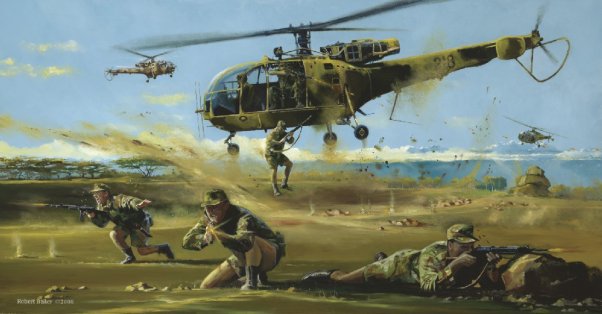
Permission was granted for this experiment and he returned to Mt. Darwin as an unattached medic. He would go on whatever fire-force operation was called up. In December of that year, the tempo increased and he was on almost continuous duty. The RLI was racking up kills with few casualties of its own. Coey had a close call when one of the choppers he was on was came under fire with the pilot being shot. Fortunately, the co-pilot put the bird down without further injury.

Coey spent Christmas in Salisbury, which he admitted was very ‘lonely,’ but he remained motivated. He recounts that his performance in Fire Force was enough to have most medics retrained with the capability to act as medic and infantryman. In influencing the Army, he felt that he was expunging the humiliation that had come with his dismissal from the SAS.

During the following months, he rotated in and out of Mt. Darwin and the Zambezi Valley. With renewed pride and resoluteness, he decided to apply for citizenship as a Rhodesian. In June, he was granted citizenship and also applied for a new passport as a dual citizen. “What a chuckle, filling out those papers under a portrait of Henry Kissinger !” He was now firmly committed to finishing his military service, and looked forward to possibly staying on in Rhodesia permanently.

Rotations continued, forever chasing down the Terrs, sometimes coming up dry and others resulting in heavy clashes. By this time he has participated in close to 60 Fire Force missions and had established himself in the RLI as a solid trooper and capable medic. The tone of Coey’s letters home and journal entries became less longing and more stable as he had finally found his place, contributing to the destruction of terrorists and rendering aid to his wounded soldiers. It seemed that Coey was finally content that he was carrying out the ‘historical mission’ for his life that he had spent the last 3 years trying to find.

The Last Battle

On July 19th 1975, Two Commando was posted at Mt. Darwin for Fire Force duties. 7-Troop was designated the ‘first wave.’ They would be first responders to any call outs for support to patrols who had made contact in the bush. As the Commando Medic, Coey was assigned to Lt. Du Plooy’s stick, which acted as command and control.

A TA unit had been ambushed that morning by approximately six Terrs. The TA’s returned fire, killing two, but the rest broke contact and ran. These soldiers began to track and regain contact but had no success. 7-Troop was not called out as a result but a request for trackers was fulfilled. Coey went with them to be on scene if they regained contact.

Trackers began to pick up spoor and then 7-Troop was called in for backup, as it wasn’t known if the Terrs were returning to a larger group. The tracks led them in to a dense, overgrown river bed known as a denga. With several curves in the river, it was a perfect defensive position to lay up an ambush as soldiers rounded a bend.

Moving in on the Terrs, three members of 7-Troop were shot, two fatally, one had his legs shredded. They hunkered down and awaited reinforcements due to the fact that they could neither spot the Terrs nor assess their strength. Lt. Du Pooly arrived on the scene with Coey shortly after. With the possibility of saving the life of the third wounded man, John Alan Coey slid down into the river bed and approached his fallen comrades. Unknown to either Coey or the Lieutenant, Terrs were directly underneath the insertion point. Coey was shot twice, once through the head and a second one through the ankle. The Lieutenant was also wounded.

Over the next few hours, the attempts of the RLI to dislodge the Terrs were unsuccessful as the roots and foliage were thick enough to stop grenades from penetrating their hiding spot, and nearly impossible to get a view of the location. The SAS was called in as darkness came to use their night sights. Around midnight, the Terrs broke contact and ran. It was only then that the bodies of the RLI soldiers were retrieved from the river bed. It has been a bad day for the RLI.

Aftermath, Significance and Remembrance

Fingers were pointed and soldiers lost. David Armstrong says of this contact, “The riverbed contact was the worst single event of my three years with 2 Commando and the only one in which the terrorists got the better of us…”

John Alan Coey, a citizen of both America and Rhodesia, was laid to rest with full military honors. Coey had come to Rhodesia to fight the evils of Communism, to preserve the dying off of western civilization, and fulfill what he repeatedly called his ‘historical mission in life.’ In many ways, he fought other battles along the way but remained true to his convictions, whatever the price.

Many can point out the futility of his death. They can say that it was a worthless cause and that the sacrifice was in vain. I think not. Those few guardians of the good in this world can look to his life and death and know they are in good company.

They went with songs to the battle, they were young.

Straight of limb, true of eyes, steady and aglow.

They were staunch to the end against odds uncounted,

They fell with their faces to the foe.

They shall grow not old, as we that are left grow old:

Age shall not weary them, nor the years condemn.

At the going down of the sun and in the morning,

We will remember them.


Note: This article was based solely on the Journals of JA Coey. I was able to contact his brother and he was thankful and verified that is is accurate in fact and sentiment.

The Rhodesian SAS: Selection & Operator Training

Subscribe to continue reading

Subscribe to get access to the rest of this post and other subscriber-only content.

Rhodesia’s ‘C’ Squadron- The Beginning

The U.K.’s Special Air Service needs no introduction to anyone remotely interested in military history or Special Operations. However, there is much more to learn about this elite unit when one traces its existence and influence across the once global British Empire. Much of the power of the Brits was derived from their colonies and their stock of available military recruits. Australia and New Zealand have retained the SAS as the designation of their Special Operations Forces.

After the end of the Second World War, the British government saw no further use for the unit and disbanded it in October 1945. Within a year of that decision, a reversal was made and the SAS was resurrected. They drew soldiers from the Territorial Army and continued training for future conflicts on the horizon. In 1950, Britain committed to helping the UN to stop communist aggression on the Korean Peninsula. After three months of preparation, 21 SAS was given orders to Korea. During this same period, another problem arose in Malaya, which was administered by the British. The problem perfectly suited the Unit’s capabilities.

In 1948, communist guerillas began attacking British infrastructure and challenging British rule. These insurgents were a reconstituted arm of the local units that the British had trained to fight Japanese occupiers in WWII. The terrain and tactics of the guerillas were difficult to counter with conventional forces. Sabotage and hit and run operations began against the transportation system and the lucrative rubber plantations that were vital to Britain. The guerillas would come from the impenetrable jungle and disappear back into it.

The British had learned many valuable lessons in jungle warfare while fighting the Japanese in South East Asia. This training and experience still lived on in the commanders of the Malayan detachment. With forces being committed to the Korean conflict and the need for manpower worldwide, it was decided to make a recruiting drive for men in the colonies to try out for the SAS. So troops were raised to fill A Squadron and B Squadron, mainly from experienced British Territorials who had geared up for wartime deployment to Korea.

These forces would form the Malayan Scouts (the forefathers of the modern SAS) whose primary mission would be reconnaissance and the interdiction of the Communist Terrorists (CTs) along their known supply routes. It was a steep learning curve for the two squadrons and jungle illnesses took a brutal toll.

In Search of a Few Special Men

In 1951, Major “Mad Mike” Calvert, the expedition’s commanding officer, decided to take a trip to the far away African colony of Rhodesia. Rhodesia had contributed greatly in proportion to its population in WWII and a few Rhodesians had served in the SAS. Those younger Rhodesian men, who had felt that they had missed their chance to fight for the Crown due to their youth during the ‘Big One’, applied in droves. This caused quite a stir and the applications were capped at 1,000. These 1,000 applicants were carefully screened and 100, i.e.- the top 10 percent of men were chosen to be a part of the Malayan Scouts and the now resurrected SAS.

Once they were chosen, they underwent basic training and onto the general skills of an SAS Trooper by two Rhodesian veterans of World War Two, Lt. Peter Walls and Lt. Ron Campbell-Morrison. Both were combat experienced and expected to be replaced by a British commander once in-country. With great fanfare and a crowd of 3,000 people in Salisbury, the 100 were sent off to war. Upon arrival in the harsh jungle environment, they were faced with the reality of a hard-bitten counterinsurgency campaign. The Rhodesians would be C Squadron, the unit designation that would unknowingly stick with them far into the future ( now over 70 years for a temporary unit! ).

Their reception was not a welcome one but the men of the established A Squadron made an impression on the Rhodesian recruits. Yet, being highly motivated and unspoiled, they remained hearty and willing to get on with the mission at hand.

Into the Fire

As a small, self-contained and isolated unit is often prone to, there were disciplinary problems among A squadron. While the Rhodesians did a six-week workup, discipline was restored among the other men and several of them were sent packing. After the training course in the country, it was decided that the Rhodesians would not be split up nor have a British commander. Peter Walls would command C Squadron for the duration of the deployment. During the ‘yet to come’ Bush War- the existential battle for the life of their beloved Rhodesia – Lt. Walls would later become the Combined Operations Commander for the Rhodesian Army.

The young men had been chosen for their background and ability to work with a team in a harsh environment. Rhodesia was a breeding ground for excellent soldiers. Many of the men had grown up working hard on their family farms, playing Rugby and most importantly, hunting and tracking which developed a sixth sense needed in true Light Infantry combat. Tracking in Africa was an essential skill that could not be learned overnight. They found themselves having to learn to operate in unfamiliar terrain- the jungle instead of an open, sunlit battlespace. In the Rhodesian bush, the sun would light the tracks and give the tracker information by the shadows created. This made it easier to spot spoor, making for a quick assessment and pursuit. Among the men was a youngster by the name of Ron Reid-Daly. His upcoming learning experience would eventually help revolutionize counterinsurgency warfare with the formation of the Selous Scouts in the Bush War.

The canopy of the jungle blocked the sunlight causing the men to look for different spoor than they were accustomed to. The floor of the jungle was full of rotting vegetation and oftentimes the bush was so thick that machetes had to be used to move forward. The vegetation was as much their adversary as the CTs were.

Here, the lessons of Guerilla Warfare and Counter Insurgency, took root in the Rhodesian unit. This war would not allow for the entire squadron to hack through the jungle in open pursuit of the enemy. To do so would invite ambush and death. Small unit tactics were refined to a razor’s edge. Operating in small groups, from a four- to a 14-man patrol was the norm. The conventional doctrine taught that soldiers could operate for a maximum of seven days in the jungle. Yet, the SAS had other plans.

The enemies were not large in number but their native mastery of the jungle allowed them to a lesser jungle experienced army. C Squadron’s job was to locate the CTs, take their safe havens away and destroy their supplies, ambush their trails and avenues of escape and then drive them out of the bush and into the hands of more conventional and heavily armed units. This took patience and resolve. The SAS would often spend weeks at a time tracking and piecing together the intelligence that they developed. The helicopter, a new tactical tool, allowed the men to be inserted deep into enemy-held territory and hunt their prey with the resources they had. Heavy, advanced and technologically superior air assets and pinpoint artillery strikes were rarely, if ever involved. It was mano y mano warfare of wits and skill, from the officer down to the lowly troopie. Every gun ( gat ), every bullet, every step and each recce mattered.

Typically, a team would insert into an area believed to be near to or exactly in the home of a band of CTs and plot out the areas to recon, methodically searching behind every bush for information that would lead them to their objective. A base camp would be set up and from there men would be sent in four distinct directions to create a 360-degree search area. This might go on for days or weeks until they would find a trail or a camp. Once the enemy was located, they would devise an ambush plan. It was rare to make an outright assault due to the small number of operators. Their training in Navigation, Patrolling, Snap Shooting, and Ambush was being implemented with an ever-growing proficiency.

The fresh-faced lads that arrived in 1951 turned into Men of War, Jungle Fighters, and Soldiers of the Elite C Squadron of the SAS. Their reputation as solid SAS men grew among the British. For nearly two years the valiant “100” navigated, patrolled, and battled the Communist Terrs, building not only a reputation of a competent part of the SAS but soldiers to be feared. That experience would pay off in spades and quite frankly helped hold the Rhodesians together many years beyond what it should have against a numerically superior and supplied enemy in the coming decades.

Due to their skill, patience, and fortitude, they returned home in 1953 after nearly two years of combat with only three KIA. For his leadership in a merciless environment, Lt. Walls received the MBE, Member of the Most Excellent Order of the British Empire. More important than any medals or accolades that the British gave them was the fact that a foundation was created that Rhodesia could build an elite unit on par with the rest of the world. The unit was to battle the storm that was on the horizon in an increasingly fiery Communist superpower backed, trained and supplied war for Post-Colonial Africa.

Captain Robert ‘Bob’ Mackenzie

I have officially come out of retirement to share what I have learned in the last decade both historically and as a writer. I have decided to use this website alone to provide a platform for my writing. I’ll be focusing on notable and compelling people and the events surrounding their lives. It should be free for all to read.

If an opportunity arises to share my writing on any other website, journal or unique platform I will send out a not to my growing subscribers.

My last article for SOFREP was fittingly about American Legend Bob ‘Mckenna’ Mackenzie. I was limited to 1000 words but we know that he could fill a book with all of the stories known and unknown, revealed by his friends and fellow soldiers.

https://sofrep.com/news/robert-mackenzie-an-american-soldiers-war-against-communism-in-africa/

I look forward to returning filling up pages of not widely known stories.