Originally published on SOFREP.com
The continent of Africa in the 1990s was a cauldron of warlords, failed states, and genocide. From the Rwandan genocide in the east to the decades-long civil war in Angola in the west, to the changes in post-apartheid government of South Africa, people were dying, dictators oppressed their own people, and the continent cried out for solutions.
The world’s first reaction was to send in the blue helmets of the United Nations, which normally brought a trail of bureaucracy, illicit trade, and impotency. Opportunists of all sorts, from arms manufacturers to dealers in blood diamonds, sought to profit off the immoral killing and plundering of the common villager. Instability reigned supreme.
Those soldiers and militaries from the U.N. fared poorly in their attempts to intervene and advise in these conflict zones, much less to “keep the peace.” Those soldiers from the nation of South Africa who had come through 20-plus years of fighting in familiar terrain and climate conditions, and against familiar hostile combatants, knew that to bring certain conflicts under control required African soldiers.
Enter Executive Outcomes. EO has come to represent nearly everything both good and bad about private military companies. Yet the true story is known by very few. Many journalists still mistakenly believe and print that it still exists. Other charlatans with no association with the PMC have used the name to start businesses or claimed to have worked in the conflicts associated with EO, attempting to gain employment or company contracts.
Eeben Barlow has published a book chronicling EO’s inception, contracts, and closure in his book “Against All Odds.” He tells the story from the founder and CEO’s position. It is a fascinating true story. Movies have been made, novels published, and recently, even a graphic novel has been published claiming to tell their story. Colonel (ret.) Roelf Van Heerden takes us inside the operations in Angola and Sierra Leone in his book “Four Ball One Tracer: Commanding Executive Outcomes in Angola and Sierra Leone.”
Colonel Van Heerden has soldiered for more than 40 years on the continent of Africa. In his book, he takes us through his military history and quickly paces us into the recruitment, clandestine travel, and initial landings in Angola through to EO’s final mission dismantling the RUF.
International powers that be and the U.N. were afraid of EO’s incredible performance with a minimum of personnel, equipment, and time. They put pressure on Sierra Leone and other countries to end any associations or contracts with Executive Outcomes using threats and intimidation to end world support for embattled nations. There would be no monetary loans or military assistance if they continued to allow these ‘white mercenaries’ to work and protect their nations.
Colonel Van Heerden was gracious enough to allow me to interview him about his long and storied career, which continues on today: He’s now working counter-piracy missions around the Horn of Africa. He commanded the effective release of the crew of ICEBERG 1 after 32 months of captivity, and he continues his work ‘somewhere’ in that part of the world. For more on his life story, check out his book, “Four Ball One Tracer” (it is available on Amazon in paper or a very affordable Kindle edition). Whether you are a serious student of irregular warfare in Africa or simply want to understand how the first modern private military company operated and won conflicts, this book is without equal.
He tells his story without apologies, fanfare, or any hint of vain glory as the ground commander leading his troops into battle against some of Africa’s most heinous combatants. Invest your time in this fascinating story.
SOFREP: Colonel Van Heerden, you have written the book “Four Ball One Tracer” about your time with Executive Outcomes in Angola and Sierra Leone. You began with EO as a platoon sergeant in spite of having been a full colonel in the South African Army. Can you describe your experience in the SADF?
VH: As stated in my book, I have had a stock standard military life. From both my parents I have military grandfathers and uncles who have fought on both sides of the fence, either for or against the British (Anglo-Boer War) and in WWI and WWII. One of my uncles was a fighter pilot for the RAF and was shot down three weeks prior to the end of the war by young German soldiers operating an AA gun.
Having done 12 months of National Service training, I tried my hand at mining engineering on the gold fields of South Africa, but found it to be boring and went back to join the permanent force (SADF) in 1978.
As a young servicemen at the Officers’ Training College in Heidelberg, South Africa, I was fortunate to become an officer, and I was posted to Walvis Bay in Namibia for the remainder of my National Service period. I did like the synergy found amongst young officers, and that drove me for the rest of my life.
As an officer in SWATF (South West African Territorial Forces), I was driven by the passion of closing the gap between the level officers used to have and the troops by joining them as far as I was permitted. I made it my duty to go on patrol with my troops and battle with the enemy the way the ground troops used to experience this. My four years at 102 Battalion with the Himba tribe in the Kaokoland was a very pleasant experience. This period gave me a considerable advantage in working with different cultures, which was one of the elements of my success in working in Africa. I understood their mentality and learned to use it to the full capacity.
The following military experiences (as a mechanized infantry soldier) gave me a further benchmark to lean on in the years to come, with specific mentioning of Angola. As the staff officer operations (SO-ops) at 82 Mechanized Brigade, I obtained valuable knowledge in planning and commanding armored battalions. This phase of conventional warfare was peaked with the Staff Officers Course at Army College in Pretoria.
During my last few years in the SADF, I served with the CCB (Civil Co-Operation Bureau) and with DCC (Directorate Covert Collection)—both very sensitive and politically orientated and steered. The CCB was part of the special forces under the Chief of Defense Force, and the DCC was a directorate under Chief Staff Intelligence. In both cases I was extremely fortunate in being part of those teams, and that rounded off my illustrious military career.
Soon afterward, I was part and parcel of a “selling-off” program in reducing the covert abilities of the SADF. During the above years as a (PF) permanent force officer, I had numerous battles with the then enemy (SWAPO) in both the unconventional and conventional forces.

SOFREP: Once operations against UNITA began to come together, especially after the initial operation in Soyo, a lot of men went home on a plane. Do you think people were misinformed about their jobs awaiting them, or did experience in combat have a lot to do with who stayed and who went?
VH: Like with this type of security contract work, there are always misunderstandings about what the work entails. “When the going get tough, the tough get going,” the saying goes. But I have to mention the following: We were all in the picture from the start (we had a cover story, but at some stage, reality also starts in), but the Soyo operation was and still is “madness.” A typical heli-born operation turned into full-scale conventional (staying in the trenches) operation with a high rate of casualties, turning it into hell. For some of the chaps, this was not the way they really wanted to continue, with specific reference to the way we were supported by the FAA (Forças Armadas Angolanas). In Africa, they would rather run away, hopefully to come back tomorrow. This would have left us with ourselves. The “escape” plan was straightforward: Swim for your life until you reach one of the floating buoys in the sea.
Yes, the most experienced were staying behind.

SOFREP: People often get a misconception about larger-than-life historical events. EO suffered some losses early on. Some of your former recces were a part of a rapid deployment force and were lost or wounded in early harassment contacts. Were there any other lessons for the young company apart from that?
VH: Yes, we soon learned that the best way to support your men is to remain as a “non-integrated force” and fight on your own axis of advance. This is not possible at all times, but plan toward that. Yes, train the host force to become better soldiers, but first win the fight—at least that was what needed to be done at Soyo.
SOFREP: Another misconception among readers is that you as a PMC fought all of these battles against UNITA and the RUF alone. You trained and worked with existing armies in these countries, correct?
VH: You must read this question with the previous one. Remember, there is a difference in culture in battles, and it is not possible to throw them together on one axis of advance. If you have time at hand, you can train them to do these in conjunction, but it remains a very difficult task. In Angola, I and Brig. Gen. Pepe De Castro had differences, but eventually we took turns at leading the battle. This brought about a healthy competition among fighting groups. This method needs proper commanding and good officers.

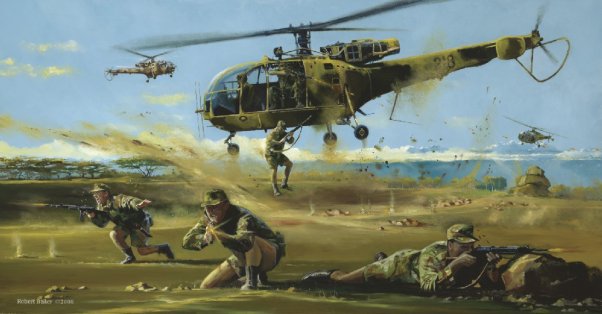
In Sierra Leone we kept the different, non-integrated ways of fighting. Although we trained them for months on end and had some battles as a joint force, we preferred to keep separated forces. Here, we were doing mainly heli-ops and using support weapons in the support role. Indirect fire was not part of the wars we experienced in Sierra Leone, and we kept that close to our chest.
The same went for the pilots flying in our battles. The SADF pilots were among the finest in the world, and our culture of using helicopters in the close support role was unique to our needs.
SOFREP: Even though you worked as advisors and trainers, you were up on line with the troops you trained. You mention that, in the SADF, being in the rear instead of in among your men was frowned upon. Can you expand on that?
VH: Yes, during my battles in both Angola and Sierra Leone, I found it to be best in being very close to the front troops. If you don’t lead, being up front, your chances are less for making progress. However, this is extremely dangerous: You are more likely to go home in a bag. This is how we had early losses at Soyo. Our men had been caught in a crossfire from own troops and the Angolans (FAA ) from behind.
SOFREP: Once you gained an objective such as a town, you engaged the locals and let them know you were here to set things right. How important do you think that was?
VH: From the start, we made them part of the plan. Secondly, they know the area, and by using them, we gained early successes.
SOFREP: Given your constraints, including manpower and equipment, do you believe that new tactics and strategy were developed during these campaigns?
VH: Yes, operating in different countries with totally different climates and terrain, you very quickly have to look at what is the best method of reaching the tactical objectives.
SOFREP: You have not written about your work after Executive Outcomes, but I understand you have done work near the Horn of Africa?
VH: Yes, I had been the operations manager at PMPF. (The Puntland Maritime Police Force.)
SOFREP: Piracy was on the radar of the world media for quite a while—even Hollywood made a movie about the Maersk Alabama. Do you feel that any long-term work has been accomplished in maritime security?
VH: When I arrived in Puntland, we had serious constraints. The U.N. Security Council did not accept PMPF as a legitimate organization. What a pity. The Puntland government is legitimate and donations from the UAE made it possible to try and stop this piracy issue, which cost the world big-time money. Secondly, the way PMPF was doing it was the only way that was cost-effective and operationally effective. Billions were spent to do it at sea. The correct and most effective way was from land. All piracy originates from land. I believe that there was never a proper appreciation done on strategic level—who and what brought it about and how these cartels were being established. The truth is that the cartels were being run by individuals. Businesslike, they have their investors who supply the cash to “babysit” the hostages and ships until ransom is paid, and then the investors are paid back double the amount invested. The logistics are run from land. Local shops are supporting whatever is needed: food, clothing, “khat,” and fuel. Even alcohol and prostitutes are on the menu.
All that needs to be done is to cut the logistics, and that needs to be done on land. That is the head of the snake.
If you asked me about any long-term work being done, my answer is no. It will surface again. It has gone “low profile” on the Somali coast, but it is not dead. NATO can run this operation much more cheaply if they assist smaller organizations like the PMPF. I had a meeting with them (through the Puntland Maritime Minister in 2013) and they refused to talk to me. I believe PMPF had been branded as a “no-no” by the U.N. Security Council and NATO.
SOFREP: Is it true that you were involved in bringing about the release of Iceberg 1? The Puntland Maritime Police have taken credit for the release. Are you able to tell us anything about ongoing work that you do in this area?
VH: Yes, during that time PMPF were isolated from their funders (UAE) and left behind while we were on the verge of catching Issi Yule, the pirate mogul then in Puntland. The management and operational core of PMPF was sent home with the exception of nine South Africans (me included). I was then ordered by the president, Mohamed Farole, to go to Garaad (where the Iceberg 1 was kept hostage for 32 months) and see what we could do to free the hostages. It took me and Admiral Abdurizak a full 13 days to free them by imposing various levels/stages of pressure (to keep the hostages alive). A very interesting operation.
SOFREP: After 40-plus years at the sharp end of the spear, is there anything you would like to say or let people know?
VH: In short, there is a definite role for PMC-type forces, and they should be taken into account, as they are very cost-effective in solving problems that could pose serious strategic and political issues for major countries. What EO did was provide a definite direction for future PMC companies. It should not be seen as a trend or a threat, but rather a solution to world security. Instead of managing these PMCs, they are being ignored and not utilized. EO worked for legitimate governments. Some of those governments were not paid attention to until EO arrived on the scene. Then EO got banned and was asked to leave the country. It does not make sense. I do understand the political sensitivity about EO, but it should be addressed properly as part of the solution.

SOFREP: Our readers are interested in not only military special operations, but also the world of intelligence and private military companies. Since 9/11, Blackwater has become synonymous with PMCs, but prior to that, Africa was host to many conflicts and counter-insurgencies. Executive Outcomes was the first major PMC to work with legitimate, elected governments. It had several major successes in Angola and Sierra Leone. Since then, so many people have tried to attach their names to EO or claim to be the successor to EO. You state in your book that you want to tell the story of what transpired on the ground during these operations. Is there anything in particular that you feel needs to be rectified?
VH: I will never try to discredit other PMCs or security companies for mimicking EO. EO was the ice-breaker for PMCs and will remain like that. The managers of EO were professional in their approach, and a sound organization was established. It became a very effective business that showed results on time. Maybe these were the reasons others went after EO. There will never be a replacement.
My book showcases what was going on during my time as commander on the ground. It is not a romantic book, but rather a guide, and I was trying to give the reader some insight systematically on our approach. It will be not that interesting for, or rather it may prove complicated for, someone who lacks a security or military background.
SOFREP: I would take exception to that last statement, Colonel! It is immensely interesting. It is not difficult to understand and I believe anyone who has an interest in private military companies or African conflicts will find it absorbing and articulately stated. Thank you for your time, and best of luck for success with your book and your work to bring peace and stability to the continent of Africa.
 The Sharp End of the Spear