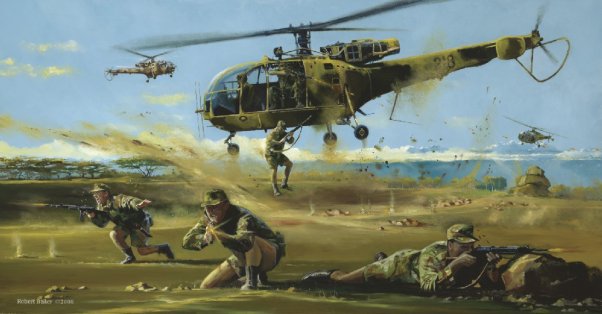
The SAS Hitting the Enemy in their Safe Havens.

Courtesy of SOFREP.com…..

BY D.R. Tharp

We explored the historical background of Rhodesia’s SAS ‘C’ Squadron. Now it is time to focus on a few of the missions that they undertook during the Rhodesian Bush War, a war that threatened to destroy the government of Rhodesia, take the land and evict those of European descent.

There are resources available (though hard to find) that follow the actions of the SAS over a decade of constant contact with the enemy. Given the long period, it would be impossible in this article to do justice to all of the actions taken by the SAS. Yet, little by little, more of the men who served are putting pen to their experiences and letting us delve into a piece of military history that is not widely studied.

Rhodesia Against The World

Just as Britain had carved up the Federation, it also made demands on the people of Rhodesia: The British wanted to govern from London a people that had carved out its living from the wilderness of Africa.

Although no formal form of Apartheid existed in Rhodesia, the British declared that Rhodesia must immediately give up white Majority rule. Unlike South Africa at the time, Native Africans were part of the Ian Smith government and the Rhodesians themselves were working towards further integrating the blacks into politics and the economy. Furthermore, the Tribal Trust Lands were administered and provided for by the government. Yet, Smith believed it would be disastrous to completely turn over the government to a people not yet integrated into the work or education necessary to govern a nation.

Ironically, the Bush War would take a higher toll on the Black Rhodesians than on the Whites Population as the Communist Terrorists slaughtered thousands of Shona and Matebele men, women, and children.

The demands from Britain led to the Unilateral Declaration of Independence from Great Britain. Rhodesia declared itself free from being ruled as a colony and would go it alone. The British immediately retaliated with sanctions on oil and other commodities in an attempt to strangle Rhodesia into submission. Fortunately, there were a few allies that defied the United Nations and helped Rhodesia in its struggle: South Africa was a stalwart ally, along with Israel and a few other Middle Eastern countries.

Much of the desire for independence revolved around the communist influences making headway into Africa. A western worldview was incompatible with altogether allowing Communist African Nationalists to run the government.

Rhodesia would have to go to war alone against communism. On a personal note, as I have discussed the war with several veterans of Rhodesia and South Africa, I have marveled at the amount of time they were deployed. In many ways it is different than the current War on Terror, in that, they had no place to rotate home to: Many veterans spent over 10 or more years on active duty, enduring hundreds and hundreds of firefights. The answer is always the same, ‘We had no choice, it was our home and we had nowhere to go.”

Immediately after the break from Britain, Rhodesia took matters into its own hands at stopping the Communist Insurgency on its borders. It was no longer worried about the British Overlords condemning its military actions nor would it suffer outright the murders of its citizens. Thus, it was decided that rather than catch the crook in his home, they would hunt him down on his own territory and prevent him from ever getting into Rhodesia.

Pursuit Into the Safe Havens

The Zimbabwe African National Union (ZANU), supported and trained by the Communist Chinese, had begun infiltrating from Zambia. Crossing the mighty Zambezi River and Valley, they were getting deeper and deeper into Rhodesia. A horrifying event finally unleashed the furor of the country and caused it to use its finest tool of war: In May of 1966, Johannes and Barbara Viljoen, farmers with children, answered a knock at the door. They were shot dead and mutilated. The anger of the nation turned on these terrorists.

Six years of preparation by the SAS were put into action. (Prior to 1966, SAS were involved in Border Interdiction and tracking down small bands of terrorists which were causing mayhem; this was an underutilization of the SAS’ capabilities.) A plan was formed to travel to Lusaka in Zambia and blow up the ZANU headquarters. Up until this mission, only senior NCOs were involved in any type of cross border activity.

The plan proceeded in October and ended in disaster. The explosives the SAS took with them malfunctioned, before they were able to infiltrate Zambia killing several of the NCOs and the specialized training along with it. The Alouette sent to recover the bodies also suffered a malfunction and crash-landed.

Trials and Tribulation

After reviewing the failure, a better plan was formulated and became the first of many external operations to come. It was called Operation Sculpture and its mission was the same: Infiltrate ZANU’s headquarters and destroy documents and anything else vital to the organization. SAS would infiltrate by light aircraft, meet an agent who would take them into Lusaka, drop them off, and pick them up afterward.

After weeks of rehearsing, it was a go. The men gathered their explosives and small arms, dressed in civilian clothing, and flew into Lusaka’s airport. The pilot taxied down the runway and when it turned to take off again, the operators jumped out and fled into the bushes. The agent showed up and drove them into town and into an unforeseen problem: Outside of the headquarters, several factions of ZANU were fighting in the streets. Not having eyes on the target before the mission was an intelligence failure. Nevertheless, the men decided to give try exited the vehicle.

They hoped that the chaos outside the HQ would allow them to secretly enter the building while the guards were watching the fighting in the streets. The leader of the team made every effort possible to find a way into the building but it was airtight. At that point, they decided to abort and fly home. The agent picked them up on time and drove them to the fence of the airport. Nerves set in badly as the pilot was late. When he finally showed up, they frantically flashed penlights at him. Once aboard and returned to Rhodesia, a series of changes were made to external operations.

As most fledgling and isolated organizations do, Rhodesian SAS had to learn from experience. The first thing that needed to be enhanced was intelligence. Had a man been in Lusaka, they would never have risked going in knowing that fighting was taking place outside their target. Secondly, they were without high-frequency communications. They were blind and deaf, relying on trust for each person to be on time where they were supposed to be. Thirdly, they had no SHTF plan. If they had to go into escape and evasion mode, what would they have done to safely reach Rhodesia? The SAS were bold men but they needed to be operationally sound to attempt cross border operations in the future.

The SAS continued to focus on the Zambian border area. ZANU, and later the Zimbabwe People’s Revolutionary Army (ZIPRA), would use Zambia as a platform to stage incursions into Rhodesia. Being remote and sparsely populated, Zambia was an ideal place, in theory, to cross over from. The problem with this was the terrain itself. The Zambezi Valley is hot, dusty, sparse in water and vegetation. Often times, the Valley did the work of the soldiers: nature simply killed terrorists off before they could inflict harm.

The SAS with the help of the Rhodesian Light Infantry and the Air Force’s Alouette Helicopters began to own the battlespace. On constant rotations in and out of the area, operators became adept at using the Valley to their advantage. The art of tracking again became a foundational skill of the SAS trooper. Those that excelled at it formed Tracking Teams that would continue to be useful throughout the war.

When on patrol or following a call out, the troopers could be resupplied with water and food, whereas, the terrorists could not. The Valley was mapped in detail and every water hole and known footpath that could be used by the terrorists was located. Many ZANU men would be lain to rest by ambushes that lay waiting for them at water holes. In essence, the SAS neutralized the terrorists by harnessing the Zambezi Valley’s harshness and leading their quarry to slaughter.

Part 2 Next…

Exciting new features Now being added- Reprints of all SOFREP articles on Rhodesia

I am excited to be reposting most if not all of my articles on Rhodesia written over the last 12 years to this website- starting TODAY. Visit often over the next week. I am grateful to Sofrep.com for granting me permission to do so. Please consider visiting their site. I am proud of these articles and hope you will enjoy. Dan

This painting is by none other than Craig Bone. A Selous Scout and Painter of all things Africa and Military.

Captain Robert ‘Bob’ Mackenzie

I have officially come out of retirement to share what I have learned in the last decade both historically and as a writer. I have decided to use this website alone to provide a platform for my writing. I’ll be focusing on notable and compelling people and the events surrounding their lives. It should be free for all to read.

If an opportunity arises to share my writing on any other website, journal or unique platform I will send out a not to my growing subscribers.

My last article for SOFREP was fittingly about American Legend Bob ‘Mckenna’ Mackenzie. I was limited to 1000 words but we know that he could fill a book with all of the stories known and unknown, revealed by his friends and fellow soldiers.

https://sofrep.com/news/robert-mackenzie-an-american-soldiers-war-against-communism-in-africa/

I look forward to returning filling up pages of not widely known stories.

Preserving History in a Time of Madness

As a lover of history, I see it as vital to keep our history, both good and bad alive and in the collective memory. Erasing the things that we consider as wrong or even evil is a mistake. Even now, you can see that the failure to teach things such as the failures Marxism through history is wrong. The things we disagree with the most should be studied in a way that is equally balance with things we believe in a collective society, or used to. Without information on the past and it’s results/ramifications is a route to disaster.

Famed South African, Mr. Eeban Barlow of the famed and now relaunched Private Military Company , Executive Outcomes eloquently discussed this on his Facebook page. With his permission, I will repost it here. From Ancient wisdom to today, people have not changed, only the technology. We are a species who easily forget yesterday.

PRESERVING HISTORY IN A TIME OF MADNESS As a country that has become focused on destroying and negating its history, there are still some who work hard at trying to preserve it. As Cicero (106BC to 43BC) taught us “History is the witness that testifies to the passing of time; it illuminates reality, vitalizes memory, provides guidance in daily life and brings us tidings of antiquity.” The good and the bad should never simply be swept under the carpet and changed to suit agendas as it shapes our future—and those who remain stuck in the past are destined to miss their future. Two men (Robert Forsythe and Mark Klein—their contact numbers are at the end of the posting), along with their team deserve a massive hat tip as they strive to make sure that our military history along with that of the Anglo Boer War is never forgotten nor simply ignored.

They are also great hosts and story tellers. A new developing facility known as Regiments is in the process of being created. Situated to the west of Pretoria in the Broederstroom area, Regiments will give a home to South African military and police forces that have been forgotten or neglected. Situated on an area where many Brit-Boer battles took place, it will give a home to these units that upheld constitutions and past members will be able to visit this facility to view their histories, see memorabilia, and attend functions that have now long passed. Talks and lectures will be presented by noted historians on these units and themed menus will be offered.

For more information, please contact Mark Klein directly. Kedar Heritage Lodge (https://kedar.co.za/) is a place where South African history and nature collide. It is built on a portion of Boekenhoutfontein, the historic farm that once belonged to President Paul Kruger and offers much more than just a venue for functions, weddings and conferences, or a day or weekend break-away. The land around Kedar is game fenced and populated with a wide variety of game, including eland, blesbok, impala, bushbuck, nyala, kudu, zebra, blue wildebeest, giraffe, and sable – making it a dream destination for nature lovers. It offers 66 African-themed stone and thatched rooms and suites, all of which are decorated with vibrant, hand-painted ethnic print fabrics and African artworks – reflecting many of Africa’s treasures. But the jewel in Kedar’s crown is not the renowned Paul Kruger Country House Museum, Kedar Spa in the Country, themed restaurants, a large swimming pool and private game drives where even black impala can be seen, but the incredible Boer War Museum.

It is a museum unlike any other and it was here that I learned a lot I never knew: There were many black people who fought with the ‘Boere’; there was a black Boer general; the Boere were saved by black people when they were attempting to withdraw from a larger British force; the British and Boere Freemasons would meet, discuss their masonry issues, and them shoot at one another the following day; the first South African athletes to partake in the Olympic Games were black men who fought alongside the Boere; the impact of the Russian involvement—along with others—on the side of the Boere, and more. Packed with uniforms, weapons, flags and histories of those partaking forces, the museum includes incredible metal sculptures made by Robert and Mark’s team. For anyone who wants to learn about the ‘forgotten history’ of the Boer War, Kedar is definitely the place to visit. It will be time well spent, and an experience never to be forgotten. After all, as Cicero taught us, it will bring us tidings of antiquity. For more information, please contact Robert Forsythe (+27 83 251 4448) or Mark Klein (+27 82 7770810). You won’t regret it.

The Proper Beginning of the War in Rhodesia

Greetings! I came across this post on Facebook. I’m not completely sure of it’s origins-I’d like to give credit to the Author of the book it came out of. If I find out, I’ll amend this entry.

The passage below describes what many believed to be the beginning of the serious battle for Rhodesia. Alot of observations about the coming war can be extrapolated. I add commentary of the things that stood out to me from a historical perspective. If you are not familiar with the Rhodesian Bush War, it is a good introduction to what kicked off larger scale military operations against the Communists Insurgents / Terrorists.

——————————————————————————————————————————

The attack on Altena Farm occurred in the early hours of 21 December 1972, during the third phase of the Rhodesian Bush War. Altena was a tobacco farm owned by Marc de Borchgrave. Rhodesian intelligence, which had been monitoring ZANLA’s activity and preparations, grew curious when over a four-week period in November 1972 sources of information suddenly began to “dry up”, in the words of historian Alexandre Binda. “They sensed that something was afoot, but their superiors brushed off their fears,”

On the 21st December 1972 a group of ten ZANLA cadres led by Rex Nhongo attacked the white-owned Altena Farm near the north-eastern village of Centenary. Having established a presence in the nearby Chiweshe Tribal Trust Territory, a cadre of Zimbabwe African National Liberation Army (ZANLA) insurgents armed with AK-47s, hand grenades, and at least one light machine gun (most likely an RPD) trekked about six miles to reach Altena. Around three o’clock that morning, the guerrillas cut the telephone lines and laid a land mine in the driveway.

Nhongo undertook a reconnaissance of the farmhouse before the attack commenced. Each insurgent then expended at least two magazines of ammunition apiece at the structure. Hand grenades were also thrown, yet despite the damage caused to the structure, only de Borchgrave’s eight-year-old daughter Jane was injured.

Late on the 22 December, a troop from the Rhodesian Special Air Service, followed shortly by the Rhodesian Light Infantry, reported to the police station in Centenary. The land mine planted in Altena’s driveway was discovered, disarmed and removed. Borchgrave and his family were sent to Whistlefield Farm, which was owned by Archie Dalgleish and his family while their family home was being repaired. Having been alerted to the de Borchgraves’ new location through sympathetic farmworkers, guerrillas from the original cadre requested permission from ZANLA to carry out another attack. After ZANLA’s area commanders in Centenary had been consulted, a raid on Whistlefield Farm was planned.

At about one o’clock on the morning of 23 December, the insurgents reconnoitred Whistlefield Farm and shelled the structure with mortar fire. An RPG-7 was aimed into the bedroom in which de Borchgrave was sleeping. The rocket hit the window frame and lightly wounded the tobacco farmer, his nine-year-old daughter Anne, and de Borchgrave. The ZANLA cadres then retreated and hid themselves.

News of the second attack reached Second Lieutenant Ian Buttenshaw and Sachse around midnight, and they deployed immediately, but having discovered a mine near Altena they disembarked from the vehicles 1 kilometre from Whistlefield and made the final approach on foot. Anne was evacuated by helicopter as the RLI and SAS secured the area for the night.

The next morning, on 24 December 1972, two tracking teams arrived at Whistlefield to assist Buttenshaw and Sachse in a 360-degree search: one was from the SAS, and led by Ron Marillier, while the other was a British South Africa Police (BSAP) team including tracking dogs. The security forces searched for tracks while also investigating reported sightings.

The tracks of the ZANLA fighters were discovered on 27 December on the western side of the farm and the trackers asked Buttenshaw and Sachse to bring the vehicles carrying the heavy equipment around to meet them. On the way the truck carrying Buttenshaw ran over a mine with one of its rear wheels, causing it to detonate. Buttenshaw himself, who was sitting on the bonnet of the vehicle, was thrown clear but Corporal Norman Moore and Trooper Pete Botha, sitting in the back, were not as fortunate, taking the brunt of the blast. Captain Gordon Holloway, behind the wheel, and Trooper Rod Boden in the passenger seat went into severe shock but were ultimately unharmed. Moore, on the other hand, died two days later from his wounds, while Botha survived but lost both legs.

In their haste, Nhongo’s cadres had not attempted to conceal their tracks as they headed west, towards the Musengezi river—Buttenshaw’s pursuant RLI men therefore realised how quickly the guerrillas were moving and sped up their chase. They discovered a recently vacated guerrilla camp. “The fire was still burning and the food still warm,” Buttenshaw writes. “From the abandoned kit a hurried departure appeared evident.”

Support was summoned from the SAS, who were tasked to set up stops along the Musengezi to the west. Buttenshaw’s men reached the top of the Musengezi valley to see Rhodesian helicopters dropping the SAS soldiers at regular intervals along the river, as well as the ZANLA cadres, who were moving straight towards one of the SAS stops. The stop opened fire and killed some; the rest of the guerrillas scattered and ran. Buttenshaw’s RLI men were then withdrawn from the follow-up for a day and a half and placed in stop positions. The chase was temporarily taken over by the SAS under Lieutenant Chris Schulenburg before Buttenshaw’s men returned on 30 December 1972.

For the first time the Rhodesian Security Forces were faced with a seemingly insoluble problem … after carrying out their attacks the terrorists had not gone to ground in bush-camps in uninhabited areas where they could eventually be tracked down … neither had they gone to ground in inhabited areas where information from the local population to the Police or Special Branch had indicated their whereabouts.

This time there was nothing. No tracks … no information. Lieutenant-Colonel Ron Reid-Daly, writing in 1982, explains the effect of ZANLA’s subversion on rural Rhodesia. The effectiveness of ZANLA’s adopted Maoist tactics was demonstrated in particular by the element of surprise they were now able to use against the security forces, and by the ability they had achieved to melt seamlessly into the local population between strikes.

The rural black people in the north-east of the country were now, almost totally subverted and intimidated” by ZANLA and provided the guerrillas with food, shelter and manpower. Rather than having the tribesmen actively volunteer information about insurgent movements and locations, as had happened during previous infiltrations, the Rhodesian Security Forces now met an increasingly silent and sometimes hostile welcome from the rural blacks.

More farm attacks took place over the following weeks, during December 1972 and January 1973, leading the security forces to set up Operation Hurricane in northern Mashonaland. This counter-insurgency operation would continue right up to 1980. “It was the start of a whole new ball game,” writes Lieutenant-Colonel R. E. H. Lockley. “The war proper had started.

  • This article, as I stated was taken from a forum on Facebook.
  • It is interesting for many reasons. Rhodesia had dealt with other incursions of the now blatantly violent Chinese trained and backed ZANU party which would eventually be led by Robert Mugabe. It involves the Terr leader Rex Nhongo who should have been dead many times over, one time being in the sights of a SAS operator operating with Darrell Watt but the fleeing man had no weapon in hand. The discipline of the SAS soldier and the ethics they operated by were not to shoot and kill a person they were not completely certain was a belligerent and could be simply a scared villager.
  • The Maoist Doctrine of melding into the people rather than operating from fixed positions where they would be located made it difficult to track down the perpetrators of these types of attacks. Note-later in the war, as the war progressed ZANLA and ZIPRA did have camps which made it easier to take out large swathes of Communist Terrorists.
  • It gave birth and realization to the RSF’s need for internal intelligence through INTAF ( Internal Affairs, a force that looked after the native population ) and the BSAP ( the British South African Police ) , the National Police Force.
  • It became necessary for all of the forces of Rhodesia including the Army to get involved and find ways to track down Terrorists before they carried out attacks. Operation Area Hurricane was opened in the North Eastern part of Rhodesia which remained a very active route of infiltration until the end of the war.
  • Events like this started the minds of people like Lt. Col. Ron Reid-Daly to come up with ways of infiltrating the indigenous people and gain intelligence and gave birth to the famed Selous Scouts, masters of Psuedo Operations.
  • Finally, with this string of military grade attacks, Rhodesia had to put itself officially on a war footing if they were to save the country and protect its people.

God and the RLI

God and the RLI ….

A tremendous post about a chaplain in the RLI posted by Mark Adams. It originally was posted in Cheetah in 1980. I will be blogging and writing some articles on the RLI in the upcoming weeks and months

“Come on Padre, how come you are talking to us about God when we have to go out and kill’?”

By Major (The Rev) Bill Blakeway

“Padre, do you want to go on Fire Force.” That question put to me by Lt Col Pat Armstrong, then O.C. of Support Commando, started my understanding and appreciation of what the RLI was all about.

I nearly had a heart attack when I looked at the stick board that evening and saw there in first wave, stop one – Padre! It was quite a serious stick – Cpl ‘Dutch’ de Klerk, ‘Ticky’ Millet, ‘Buzzard’ Dalgerous and yours truly. Fortunately, the only contact we made that day was with ‘Buff Beans’. But I shall never forget the almost paralysing fear as the chopper circled the target area. For me the moment of truth. I have recalled that “heavy war story” because that experience helped me to know something of what the members of the Battalion had to go through every time the siren went off. I don’t think it is possible for a Padre to begin to communicate with the Troopie unless he has been frightened with him.

My association with the Battalion started during 1974, whilst I was still a T.A. Right from the beginning, to me, there was something “special” about the Unit. It also became clear to me that there was a tremendous pride in the Unit by its members and like all regular army units, it was a “closed shop” to anyone on the outside. 1 soon realised that 1 would have to become a regular if I was to stand any hope of being accepted. It was during the first half of 1976 that the Chaplain General said “You are now officially Chaplain to the RLI get on and know them.”

It would take far more than this article and would be impossible to recall and record everything I would like to of these last six years. The Padre’s Hour for instance. You know that exciting period during the week when most of the ouens catch up on their gonk! I recall a few anxious moments when difficult questions have come up, like . . “Come on Padre, how come you are talking to us about God when we have to go out and kill’?” If anyone thinks there is an easy answer to that one – good luck. All I could do was to help the troopie to see that the country had the right to both rule and defend itself, and that the Christian had a moral obligation to be involved in both. I would also like to say that during the whole of my association with the Battalion, I have not come across one man who claimed categorically that he is an atheist. They might not have been Church-goers, but they accepted the fact that there was “someone up there” looking after them.

My trips to the bush to visit the different Commandos – few Chaplains had the privileges that I had in this respect. To be accepted as part of the Unit. I remember incidents like Forbes Border Post with 2 Commando, hot extraction demonstration with 3 Commando – with me hanging from that bar and the chopper circling a couple of hundred feet up – when I could have been back home sitting having tea with the old ladies of the Church! Being one of six sticks, total 24, and being told by the O.C. that 75 to 100 enemy had been sighted – I didn’t stop shaking for an hour.

The occasional patrol clinging hopefully to the promises of the Log Enslins and Charlie Warrens of: “Dont worry, Padre, we will look after you.” Another moment that aged me twenty years was when the present CO Lt-Col Aust was 2IC. We were discussing the various para courses and he said: “Do you want to be para-trained?” As I was still stumbling over my answer he picked up the phone, spoke to the para school and asked them if the Padre could get on a course. I sat completely speechless as I heard him say: “Right, thanks, — three weeks’ time.” Once again, however, what a privilege to be accepted as one who has jumped with the Battalion – even if they were only fun jumps.

There have been the sad times …. having to go and visit N.O.K. of members of the Battalion and giving them the one message they were dreading. The happy times at the get-togethers and marriages. The proud moments. There is no doubt that to me, personally, the supreme moment of pride was on the 1st February, 1979 when the Statue of the Troopie was unveiled. To have been part of that magnificent ceremony will always be the most treasured memory that I will have.

And who of those who were there will ever be able to forget the Memorial Service on 12th September, 1979, and the funeral service for Major Bruce Snelgar, held at the foot of the statue. Or that final Wreath-Laying. Possibly there will be those who will read this and say “the Padre’s being carried away again.” All I know is that those who have served in the Battalion will know exactly what I am saying. They will understand the fierce feeling of pride that the men in the Unit, and its achievement, coupled with the memory of those of their number who did not return from the op area.
As the Padre remembers, he would also like to say “Thank You”. Thank you to the men of the green and silver, for your professionalism as soldiers, for your courage, for your loyalty to the cause for which you fought. And I thank you for your personal friendship.

Remember this, we’re going to be in that number when the SAINTS GO MARCHING IN!

From the October 1980 Cheetah magazine.

Great Video to watch

Hard to get a 10 minute video on youtube but here is is one. Note-This video is good. Though it shows some Selous Scouts- its mostly RLI / RAR men and inserts and an RAR song, it’s titled the Selous Scouts memories. Shows some of the terrain Rhodesian Soldiers fought in and the 4 man basic stick and their weapons. Some probably C squadron SAS HALO jumps, etc. Enjoyable, regardless of the title.