Four Ball, One Tracer: An interview with Author and Professional Soldier Roelf Van Heerden

Originally published on SOFREP.com


The continent of Africa in the 1990s was a cauldron of warlords, failed states, and genocide. From the Rwandan genocide in the east to the decades-long civil war in Angola in the west, to the changes in post-apartheid government of South Africa, people were dying, dictators oppressed their own people, and the continent cried out for solutions.

The world’s first reaction was to send in the blue helmets of the United Nations, which normally brought a trail of bureaucracy, illicit trade, and impotency. Opportunists of all sorts, from arms manufacturers to dealers in blood diamonds, sought to profit off the immoral killing and plundering of the common villager. Instability reigned supreme.

Those soldiers and militaries from the U.N. fared poorly in their attempts to intervene and advise in these conflict zones, much less to “keep the peace.” Those soldiers from the nation of South Africa who had come through 20-plus years of fighting in familiar terrain and climate conditions, and against familiar hostile combatants, knew that to bring certain conflicts under control required African soldiers.


Enter Executive Outcomes. EO has come to represent nearly everything both good and bad about private military companies. Yet the true story is known by very few. Many journalists still mistakenly believe and print that it still exists. Other charlatans with no association with the PMC have used the name to start businesses or claimed to have worked in the conflicts associated with EO, attempting to gain employment or company contracts.

Eeben Barlow has published a book chronicling EO’s inception, contracts, and closure in his book “Against All Odds.” He tells the story from the founder and CEO’s position. It is a fascinating true story. Movies have been made, novels published, and recently, even a graphic novel has been published claiming to tell their story. Colonel (ret.) Roelf Van Heerden takes us inside the operations in Angola and Sierra Leone in his book “Four Ball One Tracer: Commanding Executive Outcomes in Angola and Sierra Leone.”

Colonel Van Heerden has soldiered for more than 40 years on the continent of Africa. In his book, he takes us through his military history and quickly paces us into the recruitment, clandestine travel, and initial landings in Angola through to EO’s final mission dismantling the RUF.

International powers that be and the U.N. were afraid of EO’s incredible performance with a minimum of personnel, equipment, and time. They put pressure on Sierra Leone and other countries to end any associations or contracts with Executive Outcomes using threats and intimidation to end world support for embattled nations. There would be no monetary loans or military assistance if they continued to allow these ‘white mercenaries’ to work and protect their nations.

Colonel Van Heerden was gracious enough to allow me to interview him about his long and storied career, which continues on today: He’s now working counter-piracy missions around the Horn of Africa. He commanded the effective release of the crew of ICEBERG 1 after 32 months of captivity, and he continues his work ‘somewhere’ in that part of the world. For more on his life story, check out his book, “Four Ball One Tracer” (it is available on Amazon in paper or a very affordable Kindle edition). Whether you are a serious student of irregular warfare in Africa or simply want to understand how the first modern private military company operated and won conflicts, this book is without equal.

He tells his story without apologies, fanfare, or any hint of vain glory as the ground commander leading his troops into battle against some of Africa’s most heinous combatants. Invest your time in this fascinating story.


SOFREP: Colonel Van Heerden, you have written the book “Four Ball One Tracer” about your time with Executive Outcomes in Angola and Sierra Leone. You began with EO as a platoon sergeant in spite of having been a full colonel in the South African Army. Can you describe your experience in the SADF?

VH: As stated in my book, I have had a stock standard military life. From both my parents I have military grandfathers and uncles who have fought on both sides of the fence, either for or against the British (Anglo-Boer War) and in WWI and WWII. One of my uncles was a fighter pilot for the RAF and was shot down three weeks prior to the end of the war by young German soldiers operating an AA gun.

Having done 12 months of National Service training, I tried my hand at mining engineering on the gold fields of South Africa, but found it to be boring and went back to join the permanent force (SADF) in 1978.

As a young servicemen at the Officers’ Training College in Heidelberg, South Africa, I was fortunate to become an officer, and I was posted to Walvis Bay in Namibia for the remainder of my National Service period. I did like the synergy found amongst young officers, and that drove me for the rest of my life.

As an officer in SWATF (South West African Territorial Forces), I was driven by the passion of closing the gap between the level officers used to have and the troops by joining them as far as I was permitted. I made it my duty to go on patrol with my troops and battle with the enemy the way the ground troops used to experience this. My four years at 102 Battalion with the Himba tribe in the Kaokoland was a very pleasant experience. This period gave me a considerable advantage in working with different cultures, which was one of the elements of my success in working in Africa. I understood their mentality and learned to use it to the full capacity.

The following military experiences (as a mechanized infantry soldier) gave me a further benchmark to lean on in the years to come, with specific mentioning of Angola. As the staff officer operations (SO-ops) at 82 Mechanized Brigade, I obtained valuable knowledge in planning and commanding armored battalions. This phase of conventional warfare was peaked with the Staff Officers Course at Army College in Pretoria.

During my last few years in the SADF, I served with the CCB (Civil Co-Operation Bureau) and with DCC (Directorate Covert Collection)—both very sensitive and politically orientated and steered. The CCB was part of the special forces under the Chief of Defense Force, and the DCC was a directorate under Chief Staff Intelligence. In both cases I was extremely fortunate in being part of those teams, and that rounded off my illustrious military career.

Soon afterward, I was part and parcel of a “selling-off” program in reducing the covert abilities of the SADF. During the above years as a (PF) permanent force officer, I had numerous battles with the then enemy (SWAPO) in both the unconventional and conventional forces.

SOFREP: Once operations against UNITA began to come together, especially after the initial operation in Soyo, a lot of men went home on a plane. Do you think people were misinformed about their jobs awaiting them, or did experience in combat have a lot to do with who stayed and who went?

VH: Like with this type of security contract work, there are always misunderstandings about what the work entails. “When the going get tough, the tough get going,” the saying goes. But I have to mention the following: We were all in the picture from the start (we had a cover story, but at some stage, reality also starts in), but the Soyo operation was and still is “madness.” A typical heli-born operation turned into full-scale conventional (staying in the trenches) operation with a high rate of casualties, turning it into hell. For some of the chaps, this was not the way they really wanted to continue, with specific reference to the way we were supported by the FAA (Forças Armadas Angolanas). In Africa, they would rather run away, hopefully to come back tomorrow. This would have left us with ourselves. The “escape” plan was straightforward: Swim for your life until you reach one of the floating buoys in the sea.

Yes, the most experienced were staying behind.

Roelf and Brigadier General Pepe de Castro in consultation prioer to an attack on Cafunfu, Angola.

SOFREP: People often get a misconception about larger-than-life historical events. EO suffered some losses early on. Some of your former recces were a part of a rapid deployment force and were lost or wounded in early harassment contacts. Were there any other lessons for the young company apart from that?

VH: Yes, we soon learned that the best way to support your men is to remain as a “non-integrated force” and fight on your own axis of advance. This is not possible at all times, but plan toward that. Yes, train the host force to become better soldiers, but first win the fight—at least that was what needed to be done at Soyo.

SOFREP: Another misconception among readers is that you as a PMC fought all of these battles against UNITA and the RUF alone. You trained and worked with existing armies in these countries, correct?

VH: You must read this question with the previous one. Remember, there is a difference in culture in battles, and it is not possible to throw them together on one axis of advance. If you have time at hand, you can train them to do these in conjunction, but it remains a very difficult task. In Angola, I and Brig. Gen. Pepe De Castro had differences, but eventually we took turns at leading the battle. This brought about a healthy competition among fighting groups. This method needs proper commanding and good officers.

In Sierra Leone we kept the different, non-integrated ways of fighting. Although we trained them for months on end and had some battles as a joint force, we preferred to keep separated forces. Here, we were doing mainly heli-ops and using support weapons in the support role. Indirect fire was not part of the wars we experienced in Sierra Leone, and we kept that close to our chest.

The same went for the pilots flying in our battles. The SADF pilots were among the finest in the world, and our culture of using helicopters in the close support role was unique to our needs.

SOFREP: Even though you worked as advisors and trainers, you were up on line with the troops you trained. You mention that, in the SADF, being in the rear instead of in among your men was frowned upon. Can you expand on that?

VH: Yes, during my battles in both Angola and Sierra Leone, I found it to be best in being very close to the front troops. If you don’t lead, being up front, your chances are less for making progress. However, this is extremely dangerous: You are more likely to go home in a bag. This is how we had early losses at Soyo. Our men had been caught in a crossfire from own troops and the Angolans (FAA ) from behind.

SOFREP: Once you gained an objective such as a town, you engaged the locals and let them know you were here to set things right. How important do you think that was?

VH: From the start, we made them part of the plan. Secondly, they know the area, and by using them, we gained early successes.

SOFREP: Given your constraints, including manpower and equipment, do you believe that new tactics and strategy were developed during these campaigns?

VH: Yes, operating in different countries with totally different climates and terrain, you very quickly have to look at what is the best method of reaching the tactical objectives.

SOFREP: You have not written about your work after Executive Outcomes, but I understand you have done work near the Horn of Africa?

VH: Yes, I had been the operations manager at PMPF. (The Puntland Maritime Police Force.)

SOFREP: Piracy was on the radar of the world media for quite a while—even Hollywood made a movie about the Maersk Alabama. Do you feel that any long-term work has been accomplished in maritime security?

VH: When I arrived in Puntland, we had serious constraints. The U.N. Security Council did not accept PMPF as a legitimate organization. What a pity. The Puntland government is legitimate and donations from the UAE made it possible to try and stop this piracy issue, which cost the world big-time money. Secondly, the way PMPF was doing it was the only way that was cost-effective and operationally effective. Billions were spent to do it at sea. The correct and most effective way was from land. All piracy originates from land. I believe that there was never a proper appreciation done on strategic level—who and what brought it about and how these cartels were being established. The truth is that the cartels were being run by individuals. Businesslike, they have their investors who supply the cash to “babysit” the hostages and ships until ransom is paid, and then the investors are paid back double the amount invested. The logistics are run from land. Local shops are supporting whatever is needed: food, clothing, “khat,” and fuel. Even alcohol and prostitutes are on the menu.

All that needs to be done is to cut the logistics, and that needs to be done on land. That is the head of the snake.

If you asked me about any long-term work being done, my answer is no. It will surface again. It has gone “low profile” on the Somali coast, but it is not dead. NATO can run this operation much more cheaply if they assist smaller organizations like the PMPF. I had a meeting with them (through the Puntland Maritime Minister in 2013) and they refused to talk to me. I believe PMPF had been branded as a “no-no” by the U.N. Security Council and NATO.

SOFREP: Is it true that you were involved in bringing about the release of Iceberg 1? The Puntland Maritime Police have taken credit for the release. Are you able to tell us anything about ongoing work that you do in this area?

VH: Yes, during that time PMPF were isolated from their funders (UAE) and left behind while we were on the verge of catching Issi Yule, the pirate mogul then in Puntland. The management and operational core of PMPF was sent home with the exception of nine South Africans (me included). I was then ordered by the president, Mohamed Farole, to go to Garaad (where the Iceberg 1 was kept hostage for 32 months) and see what we could do to free the hostages. It took me and Admiral Abdurizak a full 13 days to free them by imposing various levels/stages of pressure (to keep the hostages alive). A very interesting operation.

SOFREP: After 40-plus years at the sharp end of the spear, is there anything you would like to say or let people know?

VH: In short, there is a definite role for PMC-type forces, and they should be taken into account, as they are very cost-effective in solving problems that could pose serious strategic and political issues for major countries. What EO did was provide a definite direction for future PMC companies. It should not be seen as a trend or a threat, but rather a solution to world security. Instead of managing these PMCs, they are being ignored and not utilized. EO worked for legitimate governments. Some of those governments were not paid attention to until EO arrived on the scene. Then EO got banned and was asked to leave the country. It does not make sense. I do understand the political sensitivity about EO, but it should be addressed properly as part of the solution.

SOFREP: Our readers are interested in not only military special operations, but also the world of intelligence and private military companies. Since 9/11, Blackwater has become synonymous with PMCs, but prior to that, Africa was host to many conflicts and counter-insurgencies. Executive Outcomes was the first major PMC to work with legitimate, elected governments. It had several major successes in Angola and Sierra Leone. Since then, so many people have tried to attach their names to EO or claim to be the successor to EO. You state in your book that you want to tell the story of what transpired on the ground during these operations. Is there anything in particular that you feel needs to be rectified?

VH: I will never try to discredit other PMCs or security companies for mimicking EO. EO was the ice-breaker for PMCs and will remain like that. The managers of EO were professional in their approach, and a sound organization was established. It became a very effective business that showed results on time. Maybe these were the reasons others went after EO. There will never be a replacement.

My book showcases what was going on during my time as commander on the ground. It is not a romantic book, but rather a guide, and I was trying to give the reader some insight systematically on our approach. It will be not that interesting for, or rather it may prove complicated for, someone who lacks a security or military background.

SOFREP: I would take exception to that last statement, Colonel! It is immensely interesting. It is not difficult to understand and I believe anyone who has an interest in private military companies or African conflicts will find it absorbing and articulately stated. Thank you for your time, and best of luck for success with your book and your work to bring peace and stability to the continent of Africa.

Captain Robert ‘Bob’ Mackenzie

I have officially come out of retirement to share what I have learned in the last decade both historically and as a writer. I have decided to use this website alone to provide a platform for my writing. I’ll be focusing on notable and compelling people and the events surrounding their lives. It should be free for all to read.

If an opportunity arises to share my writing on any other website, journal or unique platform I will send out a not to my growing subscribers.

My last article for SOFREP was fittingly about American Legend Bob ‘Mckenna’ Mackenzie. I was limited to 1000 words but we know that he could fill a book with all of the stories known and unknown, revealed by his friends and fellow soldiers.

https://sofrep.com/news/robert-mackenzie-an-american-soldiers-war-against-communism-in-africa/

I look forward to returning filling up pages of not widely known stories.

Horseback Warriors of Rhodesia

I would like to let readers know that I have released an interview with Michael Watson a former member of the Greys Scouts, a horseback light infantry unit in the Rhodesian Bush War. It is not a very well known unit but deserves attention by military historians. Thank you to Mr. Watson and the best of luck with his future endeavors on writing his compilation and hopefully, we can get some more info up on SOFREP.com about specific dust ups and ops.

Please read and post it on your facebook, twitter, etc.

http://sofrep.com/15456/greys-scouts-interview/


Fire Force Part 3

Reconnaissance was key for successful Fire Force Operations. For this, the Selous Scouts were the leading source of sightings and initial battle plans. The Scouts operated in a variety of roles from direct action missions, active recon or sitting on top of a mountain awaiting iInsurgents to appear along known infiltration routes. However the intel was received, swift reaction was the order of the day.

When the ‘Call Out’ came across the loud speaker, the Commando would move into action. Everything the soldier or pilot needed would be queued up and ready to go. Depending on the rotation, the soldiers would assemble in tents with their webbing and weapons prepared and ready. After a brief FRAGO (if they were lucky; often battle plans were made en route to the location) they would move to their aircraft.


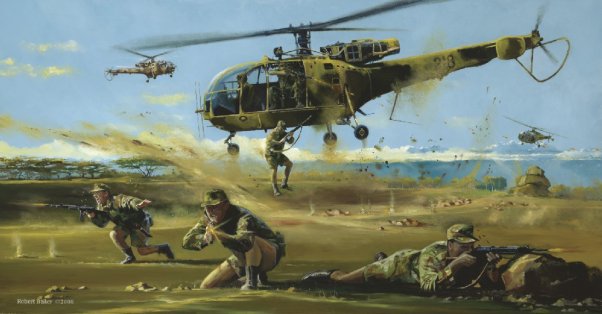
The initial wave of Fire Force troops would board the Alouette helicopters and lift off. Four helicopters carried the point of the spear. The formation consisted of one K-Car and three G-Cars.

The K-Car was the Command and ‘Kill’ car. This served as an aerial command post with a crew of three – Pilot, Gunner/Crew Chief/Tech and the Fire Force Commander.

The G-Cars carried a crew of Pilot and Gunner plus the 4 man stick. The troop carriers were customized by turning the front row seats towards the back. This facilitated a quicker exit of the chopper and allowed a stretcher to be placed on the floor for a casevac.

The K-Car was armed with a 20mm 151/20 auto cannon, which was devastating in the hands of an experienced Gunner. While the G-Cars dropped their Troopers, the K-Car and Fire Force Commander would survey the battlefield and communicate with the Stick Leaders on the ground, directing fire and helping the sticks locate and engage the enemy. Orbiting the battle at around 800 feet, the Gunner was able to use the cannon to kill as well as fix the location of the enemy.

Often, the K-Car would circle the battlefield for several minutes while the FF Commander would assess the terrain, the available troops and the likely movements of the Terrorists. If the Daks and their sticks were available, this gave the Commander more possibilities for sealing up the area.

If the numbers of Terrorists were large and in the open, a call for the Reims-Cessna 337G Lynx to make a bombing run, dropping anti-personnel munitions or napalm was made prior to insertion. The Lynx would stay on station to employ its guns or return to base to re-arm.

Once the FF Commander was able to put together all of the variables he could then act. As the war grew in intensity in the mid to late 1970′s, more men were parachute-qualified. This would prove vital to a successful operation. With the Dakota able to drop up to 20 RLI soldiers out of a single aircraft, it was the preferred option for a large direct sweep, with the G-Car sticks acting as stop groups for the enemy that ran from the K-Car and the Sweep.

In the American Military amongst paratroopers, a combat jump is usually a once in a lifetime or generation event. In the Bush War, it was just part of the job. The ideal static line jump occurred between 400-600 feet. Often times, the altitude was 300 feet or below. This could quickly turn into a totally wrecked sweep line if the pilot made an error, such as the slant of the DZ with the end of the lane rising higher than the beginning. Astoundingly, a RLI soldier holds the official record for Combat Jumps at 73′!

Once the drop was made, the Troopers immediately discarded their parachutes and left them for a tail force, or ‘wanker’ group, to police them up. These men would come in via helicopter or on troop trucks depending on the location. Stick leaders accounted for all of their troops and their condition and then linked up with each other and the K-Car via Radio for instructions.

With the K-Car delivering cannon fire, the Terrorists would often ‘Bombshell’ or scatter away and head for vegetation or any type of cover they could find. A skilled pilot and gunner developed the ability to push the enemy towards the main Sweep line.

By now, the G-Car sticks would be heading to positions awaiting the fleeing men. Zipped up between the K-Car, the oncoming Sweep and stop groups, there were few options left.

In spite of all directions being covered, it was easy to lose sight of men once they entered the bush. In many cases, the original source of intelligence, the Scouts, were still atop their position and would give the FF Commander locations and routes of the quarry.

In constant communication with the Commander, the Sweep would move ahead. A skirmish line was preferred with the ability for each Trooper to have visual contact with the man to his right and left.

It was now up to the boots on the ground to close with the enemy and kill them.

Some of the Terrs would simply run as far and as fast as they could without trying to engage. Many stories have been written about the dry creek bed that the Trooper had been posted to and the fleeing Terr meeting with a quick death in a hail of gunfire. Often at point blank range to ensure that there was no wasting of ammunition.

Three rules the Sweep used to enhance their safety and success were 1) to never sweep up a hill. They would often flank to the top and sweep downwards. 2) never sweep into the sunlight. This was the responsibility of the FF Commander when placing initial sticks. 3) Always sweep from cover into open ground, never from open ground to cover. These were often difficult to adhere to due to the type of terrain in Rhodesia.

Ideally, the Sweep would make contact in a relatively short time, exploiting the confusion and speed with which the attack had come. The enemy were reportedly poor marksmen (one technique taught to the terrorists was to put the AK over the shoulder pointing backwards and run away!).

From a distance, bullets usually cracked over their heads due to the rising propensity of the AK-47 on automatic. Upon contact troopers would either drop to one knee or go prone and begin to employ the marksmanship skills they had drilled into them, scanning for possible cover and drilling their positions.

When they were sure of the location of the incoming fire, they would employ Fire and Movement drills familiar to infantrymen around the world. Depending on the amount of men available and the terrain, the Skirmish line would end up in a complete overrun of the position.

The first F and M would split the men in half with one firing while the other moved forward, leapfrogging their way forward. The second method called for every other man to rush forward while the man next to him covered. The third was called the Pepper Pot. From a prone position, random men would jump up and move forward under cover of the others. This was the most difficult to counter and was most common amongst individual sticks.

If they moved into the bush, the pace would slow and the skill set of snap shooting on the Jungle Walk would be used. Troopers were taught to look through, not at the vegetation. It took a lot of experience to develop an eye for spotting the enemy. Many Terrs who were ill-trained and ill-motivated would simply try to hide, knowing that they were surrounded. Face to Face encounters were not uncommon for the Rhodesian Soldier.

Once the pressure had been put upon those willing to fight, anyone not hiding fled. Stop groups were not always successful at bagging the last left alive, even though the FF Commander was able to orbit the battlefield and move the stop groups to strategic exit routes.

At this point another Elite unit of the Rhodesian Army was brought in: the Tracking Combat Unit. Once ferried in, they would find the spoor of those who made it out and track them down until they were either found or the mission called off.

So determined and keen were these men that one story stands out to the tenacity of the unit. After an escaped Terr fled the scene of a FireForce Mission, for 3 days and 3 nights, the trackers pursued him until the tracks stopped and he was found hiding behind a tree. He was captured and put into criminal proceedings. He protested against the brutality of the Trackers, saying he ‘was hunted down like a dog’!

Once the shooting stopped, the work continued. All bodies were recovered and recorded. Troopers were responsible for dragging the bodies of the men they had just killed into a central area where members of the Special Branch could investigate and look for intelligence. Depending on the size and length of the operation, Call Outs and Contacts could occur up to 3 times in a day.

The rotation of a typical RLI soldier would consist of 6-10 weeks in the bush with two weeks of R&R. Unlike America’s wars of the present and past, Rhodesia was fighting for its home, its literal ground underneath its feet. Should they lose the war, they would no longer exist as a nation.

Motivation was high.

Many Rhodesians served in an ongoing shooting war on its doorsteps for close to two decades and knew nothing except War and Soldiering. After Robert Mugabe took over the nation at the opening of the 1980′s, these exceptional soldiers from the RLI and the SAS and other elite units moved on to provide their experience to South Africa and spend another decade fighting against Communism.

Fire Force is just one example of the Rhodesian’s COIN techniques. Even within Fire Force, there is much more to be researched. Many fine books have been written by Military Historians and by those who served. Two fine books written by the soldiers themselves are Chris Cock’s “FireForce – One Man’s War in the Rhodesian Light Infantry”, and Charlie Warren’s “RLI – Stick Leader.” I also recommend visiting Professor JRT Woods website for more information.

Read more: http://sofrep.com/7798/fire-force-rhodesias-coin-killing-machine-part-3/#ixzz23G0a7me4

Read more: http://sofrep.com/7798/fire-force-rhodesias-coin-killing-machine-part-3/#ixzz23G0Ui2wP

Read more: http://sofrep.com/7798/fire-force-rhodesias-coin-killing-machine-part-3/#ixzz23G0OtEk3

Read more: http://sofrep.com/7798/fire-force-rhodesias-coin-killing-machine-part-3/#ixzz23G0JQXRt

The Rhodesian Light Infantry- Fire Force

I am reposting the three part article I wrote for http://www.sofrep.com a couple of months ago. They are the finest website by far regarding Special Operations and related topics. Thanks to Jack Murphy and Brandon Webb for allowing me to contribute to their site.

BTW, I will soon be releasing a series on the history of the Rhodesian SAS, C Squadron during the Bush War.

Fire Force: Rhodesia’s COIN Killing Machine

Part 1

The helicopter has become an iconic image of war. It changed the way soldiers were able to deploy on the battlefield, dramatically reduced the mortality rate of wounded soldiers and delivers hell fire and brimstone to the enemy. To most Americans, the Bell UH-1 Huey in Vietnam was synonymous with the war itself. To the soldier in the field it was a ride in and a lifeline out.

The American military first saw its utility in the Korean War as an airborne ambulance and cargo carrier. The technology for an offensive weapon did not yet exist. However, the British were putting the new aircraft to good use for counter insurgency missions by the SAS and SBS in the Malayan Emergency that was fought between 1948 and 1960. Special troops were infiltrated and ex-filtrated deep into the jungle, bypassing traditional methods of troop movement with great effectiveness.

The platforms for offensive capabilities began to emerge and platforms such as the Huey and Cobra gunships came to prominence on the battlefield. They have continued to improve and are integral to the missions carried out today. It is a tool that our enemies fear.

With the start of the Cold War, the United States trained its military to fight against the Soviet Union in set piece fashion. The Korean War was fought against a uniformed and recognized foe. Vietnam threw a wrench into the status quo, yet the veterans and policy makers who had lived through and fought World War Two tried to apply traditional methods and tactics at a guerilla army.

Late in 1965, when the first air-mobile teams fought in the Ia Drang valley against regular NVA formations, they did well. It was a morale booster for the Pentagon and the public that we could insert troops via chopper onto the doorstep of the enemy and defeat them. History then tells us about the failure of the powers that be to further adapt methods to fight against a guerilla army. Colonel David Hackworth recognized this early in the Vietnam War and wrote the famous ‘Vietnam Primer’. He believed that with superior tactics and mobility we could learn to fight the VC and win by, in his words-,  ‘Out G-ing the G’.

Perhaps the most innovative use of the helicopter and Special Forces in Vietnam was the Mobile Strike Force and the lesser known Eagle Flight, a heliborne tactic to find, fix and kill the Viet Cong.

The Eagle Flight typically consisted of 11 helicopters, six carrying paratroops and the others acting as gunships. Soldiers were set down in strategic positions to cordon off groups of insurgents, either closing with them on foot or being blasted from above. Due to the terrain of Vietnam, it was often difficult to find the ideal kill zone.

While the Hot Spot for the Cold War was winding down in Vietnam, the African Continent was waging its own war against Communism. The power vacuum left by the decolonization of several nations allowed Soviet-bloc and Chinese backed revolutionaries to set up power and fight their way into power.

A small, independent country stood alone and against the world and the Communist tide. Battered by sanctions and abandoned over politics with the U.S. and Great Britain, the nation of Rhodesia was enduring attacks and infiltrations of its sovereign borders. Communist Terrorists were harboring in Mozambique, Zambia and Botswana and making incursions into Rhodesia, killing farmers, destroying livestock, crops and creating a panic amongst the native tribes and the general population.

Backed by the Chinese and Russians, Robert Mugabe’s ZANLA and Joshua Nkomo’s ZIPRA forces, intended on ‘retaking’ Rhodesia from the Ian Smith government and ‘restoring’ proper ownership to the envisioned nation of Zimbabwe. Early CIA records show that the Johnson Administration recognized that this ‘Freedom Movement’ was clearly an attempt to expand Communism. Great Britain resented the declaration of independence of Rhodesia in 1965 and was not interested in helping the wayward nation in retaining it freedom. Ronald Reagan addressed Rhodesia in a 1976 radio broadcast, recognizing their fight against Communism.

The Rhodesians were on their own to preserve the land that they had cultivated into the literal Breadbasket of Africa. From the early sixties onward, they were faced with a ruthless insurgency. Though they offered troops in World War Two and the Malayan Emergency to their former patron, Britain, their own standing Army was very small and their main defense force was the British South African Police and Reservists.

It has been stated that even at the height of the insurgency, the Rhodesian Light Infantry never had more than one thousand fighting men on the ground in action at any given time. With thousands of miles of borders to protect, the aim of the Army was to meet problems with solutions that worked rather than adhere to Classical doctrine for the sake of doctrine. Several soldiers that had served with the British SAS during the Malayan Emergency understood the nature of this type of warfare and were able to help put together an Army suited to the task. This drive to protect the only place they called home produced concepts and soldiers that are still studied today to learn lessons that can help our current struggle against Insurgents world-wide.

With the 1964 murder of the farm family of Petrus Oberholtzer by ZANU terrorists, the Rhodesian Bush War began in earnest. Political dissidents were imprisoned and an attempt to maintain the safety of the nation went full steam ahead. Along with reactivation of the Special Air Service in the early 60’s, more and more men were recruited to join the Army. Rhodesia needed fighting men and solutions to effectively stop a numerically superior force.