An American Odyssey in Rhodesia (Part Two)

Originally published by SOFREP.com


In September of 1972, he found himself at a crossroads and began to express his disappointment on issues agreed upon by British Delegates and Ian Smith.

He was bother by unimpeded progress of Black Majority rule, stationing of foreign troops, an increase of parliamentary seats by nationalists, and coupling the Rhodesian dollar to the Pound.

He felt that these things were the exact opposite of the cause of independence and preservation of Western Civilization, and that African nationalism was simply a route for Communism to take over. His commitment to his enlistment vacillated, but he pressed on in hopes of fighting off the Red Hoard.

When he was posted to his unit he found it hard to bond with the troopers. Active front line troops require a certain mindset. Those living the lifestyle of possibly dying, often live their lives on the edge during their free time to escape the stress. The old adage of ‘you don’t send choir boys to fight a war’ rang especially true. Coey was a teetotaler and his mates might have taken his disinterest in the things young soldiers love as an affront.

He did manage to perform well enough to go for Officer’s Selection, which he was most excited about. His internal angst about Rhodesia adhering to a perfect ideology and an Army that enforced it caused some reluctance that was noted by the officers board. He was told, “You take life too seriously and you must project your personality and withdraw from your shell.”

He continued on but was dismissed from the course for academic and temperament issues. He began to realize that some of his views were considered subversive to the morale of the Rhodesian Army. His articles had reached the ears of people in charge and it was deemed best not to have an officer making any contrary statements to official stances within its ranks. He was rotated back to the SAS and began aggressive patrols searching out Terr camps. He determined that he would not be deterred and not falter on his personal beliefs. He enjoyed this but was still not meshing with the men of the SAS.

Things came to a head in December of 1973, when his Major said he would no longer be going on patrols and his jump pay would be revoked. He stated that Coey ‘just wasn’t worth it.’ It was a great humiliation that caused him to consider applying for a discharge, but instead he chose to go to the RLI.

Coey reassesed his purpose and goals and wrote this.

My purpose in coming to Rhodesia has been to fulfill my Christian duty of opposing Communism in two ways. First is to focus attention on the Conspiracy by refusing to be its pawn and by writing to expose it. The second is to actively fight Commuist-inpsired terrorism in Africa by Military service.

Even though he had become a victim of his own ideology in the SAS and Officers course, he was about to embark on what he felt to be his real mission and put actions behind his convictions.

Coey managed to stay on with the SAS in spite of his orders to stand down, and even went on another External to Mozambique, which caused the Major to initiate an opportunity to get rid of Coey. He demanded that he choose a different regiment or corps within the week. During this time, he reached his lowest point while in Africa.

He continued writing and published another article for Mr. Brown. He decided to take this proverbial ‘slap in the face’ as an opportunity to learn something new. It also prompted him to apply for a discharge from the Army entirely. It never went through. He had signed on for Five years and the Army was in no mood to let decent people leave. He would have to desert to get out of his contract. In the end, he remained resolute to stay with the cause that had brought him to Africa.

After a lengthy interview, he was given the option of attending the Medics Course in Bulawayo, which was six months long and would allow him to advance in rank to a full Corporal. In his journal, he wrote that he would be reposted to a combat outfit, hopefully the RLI in Salisbury.

Even though he enjoyed the education he was receiving, he wrote, “My inability to completely submit to organization has caused me much grief and embarrassment because, sometimes, I think too much of myself, instead of having confidence in those in authority over me. I have made mistakes, and they been my own fault. I cannot blame it on bad luck or circumstances. I hope I can redeem myself before leaving the Army, somehow…..”

The Rhodesian SAS: Selection & Operator Training

Subscribe to continue reading

Subscribe to get access to the rest of this post and other subscriber-only content.

Captain Robert ‘Bob’ Mackenzie

I have officially come out of retirement to share what I have learned in the last decade both historically and as a writer. I have decided to use this website alone to provide a platform for my writing. I’ll be focusing on notable and compelling people and the events surrounding their lives. It should be free for all to read.

If an opportunity arises to share my writing on any other website, journal or unique platform I will send out a not to my growing subscribers.

My last article for SOFREP was fittingly about American Legend Bob ‘Mckenna’ Mackenzie. I was limited to 1000 words but we know that he could fill a book with all of the stories known and unknown, revealed by his friends and fellow soldiers.

https://sofrep.com/news/robert-mackenzie-an-american-soldiers-war-against-communism-in-africa/

I look forward to returning filling up pages of not widely known stories.

The Rhodesian Light Infantry- Fire Force

I am reposting the three part article I wrote for http://www.sofrep.com a couple of months ago. They are the finest website by far regarding Special Operations and related topics. Thanks to Jack Murphy and Brandon Webb for allowing me to contribute to their site.

BTW, I will soon be releasing a series on the history of the Rhodesian SAS, C Squadron during the Bush War.

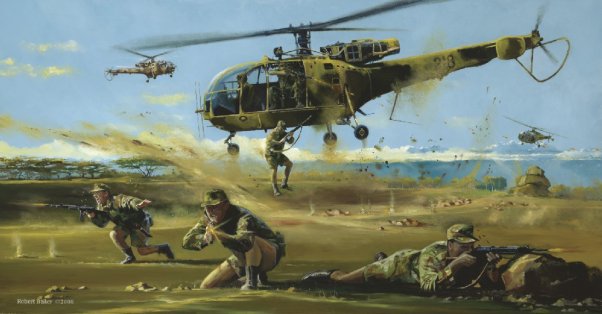
Fire Force: Rhodesia’s COIN Killing Machine

Part 1

The helicopter has become an iconic image of war. It changed the way soldiers were able to deploy on the battlefield, dramatically reduced the mortality rate of wounded soldiers and delivers hell fire and brimstone to the enemy. To most Americans, the Bell UH-1 Huey in Vietnam was synonymous with the war itself. To the soldier in the field it was a ride in and a lifeline out.

The American military first saw its utility in the Korean War as an airborne ambulance and cargo carrier. The technology for an offensive weapon did not yet exist. However, the British were putting the new aircraft to good use for counter insurgency missions by the SAS and SBS in the Malayan Emergency that was fought between 1948 and 1960. Special troops were infiltrated and ex-filtrated deep into the jungle, bypassing traditional methods of troop movement with great effectiveness.

The platforms for offensive capabilities began to emerge and platforms such as the Huey and Cobra gunships came to prominence on the battlefield. They have continued to improve and are integral to the missions carried out today. It is a tool that our enemies fear.

With the start of the Cold War, the United States trained its military to fight against the Soviet Union in set piece fashion. The Korean War was fought against a uniformed and recognized foe. Vietnam threw a wrench into the status quo, yet the veterans and policy makers who had lived through and fought World War Two tried to apply traditional methods and tactics at a guerilla army.

Late in 1965, when the first air-mobile teams fought in the Ia Drang valley against regular NVA formations, they did well. It was a morale booster for the Pentagon and the public that we could insert troops via chopper onto the doorstep of the enemy and defeat them. History then tells us about the failure of the powers that be to further adapt methods to fight against a guerilla army. Colonel David Hackworth recognized this early in the Vietnam War and wrote the famous ‘Vietnam Primer’. He believed that with superior tactics and mobility we could learn to fight the VC and win by, in his words-,  ‘Out G-ing the G’.

Perhaps the most innovative use of the helicopter and Special Forces in Vietnam was the Mobile Strike Force and the lesser known Eagle Flight, a heliborne tactic to find, fix and kill the Viet Cong.

The Eagle Flight typically consisted of 11 helicopters, six carrying paratroops and the others acting as gunships. Soldiers were set down in strategic positions to cordon off groups of insurgents, either closing with them on foot or being blasted from above. Due to the terrain of Vietnam, it was often difficult to find the ideal kill zone.

While the Hot Spot for the Cold War was winding down in Vietnam, the African Continent was waging its own war against Communism. The power vacuum left by the decolonization of several nations allowed Soviet-bloc and Chinese backed revolutionaries to set up power and fight their way into power.

A small, independent country stood alone and against the world and the Communist tide. Battered by sanctions and abandoned over politics with the U.S. and Great Britain, the nation of Rhodesia was enduring attacks and infiltrations of its sovereign borders. Communist Terrorists were harboring in Mozambique, Zambia and Botswana and making incursions into Rhodesia, killing farmers, destroying livestock, crops and creating a panic amongst the native tribes and the general population.

Backed by the Chinese and Russians, Robert Mugabe’s ZANLA and Joshua Nkomo’s ZIPRA forces, intended on ‘retaking’ Rhodesia from the Ian Smith government and ‘restoring’ proper ownership to the envisioned nation of Zimbabwe. Early CIA records show that the Johnson Administration recognized that this ‘Freedom Movement’ was clearly an attempt to expand Communism. Great Britain resented the declaration of independence of Rhodesia in 1965 and was not interested in helping the wayward nation in retaining it freedom. Ronald Reagan addressed Rhodesia in a 1976 radio broadcast, recognizing their fight against Communism.

The Rhodesians were on their own to preserve the land that they had cultivated into the literal Breadbasket of Africa. From the early sixties onward, they were faced with a ruthless insurgency. Though they offered troops in World War Two and the Malayan Emergency to their former patron, Britain, their own standing Army was very small and their main defense force was the British South African Police and Reservists.

It has been stated that even at the height of the insurgency, the Rhodesian Light Infantry never had more than one thousand fighting men on the ground in action at any given time. With thousands of miles of borders to protect, the aim of the Army was to meet problems with solutions that worked rather than adhere to Classical doctrine for the sake of doctrine. Several soldiers that had served with the British SAS during the Malayan Emergency understood the nature of this type of warfare and were able to help put together an Army suited to the task. This drive to protect the only place they called home produced concepts and soldiers that are still studied today to learn lessons that can help our current struggle against Insurgents world-wide.

With the 1964 murder of the farm family of Petrus Oberholtzer by ZANU terrorists, the Rhodesian Bush War began in earnest. Political dissidents were imprisoned and an attempt to maintain the safety of the nation went full steam ahead. Along with reactivation of the Special Air Service in the early 60’s, more and more men were recruited to join the Army. Rhodesia needed fighting men and solutions to effectively stop a numerically superior force.