An American Odyssey in Rhodesia (Part Three)

Originally published by SOFREP.com


He finished his medic course in July of 1974 and got his wish to be posted back to the RLI. He was posted in an operational area around Mt. Darwin, dealing with injuries sustained by the troops in the field. He found it to be a comfortable place where he could write and get stamps, but the boredom began to get to him. He wanted to be on the sharp end of the spear. He proposed to the CO that he wanted to go out and act as a medic and infantryman. He had both skills and the CO approved his request.

He joined the sticks going on callouts. It was here that he had a chance to treat onsite battle casualties. On one operation, he spent the night in a krall attending to some civilian casualties awaiting a casevac the next morning. A bit of a harrowing experience.

Terrorist activity increased during this time around Mt. Darwin and his skills as a medic and soldier were put to use. He noted that having a combat medic in the line increased the confidence and morale of the Troopies. Coey began to regain his sense of purpose and vigor that had brought him to Rhodesia. He writes, “It’s important for me to remain a combat soldier and a specialist medic, because only then will some people listen to you when you attempt to explain the bigger issues; of such, the battle for Rhodesia is only one.” And, “I feel that I have found my historical role here, and once that is finished, I don’t know what I’ll do….”

There was trepidation at granting his request due to the lack of trained medics at the time. He believed that in doing this it would improve the morale and respect of the Medical Corps. A Commando Medic. He cited the use of the USMC and their use of the Corpsman in the ranks of the rifle company. A medic who acted in a combatant role would serve a dual purpose of being able to fight, as well as a better chance of saving valuable troops by responding on the spot.

After some R&R he went back but was again posted to HQ. He again asked for a different posting, hopefully permanent in terms of his duties. Many people implored him to look at his duties as a medic and non-combatant as a blessing, but he would hear none of it. “I have an inner peace because I trust God to look after my safety, even if I get drilled one day. I’ll have the satisfaction of knowing that I achieved my purpose in this country, and that I gave all I could. It is important to do this even though others may betray you.”

Permission was granted for this experiment and he returned to Mt. Darwin as an unattached medic. He would go on whatever fire-force operation was called up. In December of that year, the tempo increased and he was on almost continuous duty. The RLI was racking up kills with few casualties of its own. Coey had a close call when one of the choppers he was on was came under fire with the pilot being shot. Fortunately, the co-pilot put the bird down without further injury.

Coey spent Christmas in Salisbury, which he admitted was very ‘lonely,’ but he remained motivated. He recounts that his performance in Fire Force was enough to have most medics retrained with the capability to act as medic and infantryman. In influencing the Army, he felt that he was expunging the humiliation that had come with his dismissal from the SAS.

During the following months, he rotated in and out of Mt. Darwin and the Zambezi Valley. With renewed pride and resoluteness, he decided to apply for citizenship as a Rhodesian. In June, he was granted citizenship and also applied for a new passport as a dual citizen. “What a chuckle, filling out those papers under a portrait of Henry Kissinger !” He was now firmly committed to finishing his military service, and looked forward to possibly staying on in Rhodesia permanently.

Rotations continued, forever chasing down the Terrs, sometimes coming up dry and others resulting in heavy clashes. By this time he has participated in close to 60 Fire Force missions and had established himself in the RLI as a solid trooper and capable medic. The tone of Coey’s letters home and journal entries became less longing and more stable as he had finally found his place, contributing to the destruction of terrorists and rendering aid to his wounded soldiers. It seemed that Coey was finally content that he was carrying out the ‘historical mission’ for his life that he had spent the last 3 years trying to find.

The Last Battle

On July 19th 1975, Two Commando was posted at Mt. Darwin for Fire Force duties. 7-Troop was designated the ‘first wave.’ They would be first responders to any call outs for support to patrols who had made contact in the bush. As the Commando Medic, Coey was assigned to Lt. Du Plooy’s stick, which acted as command and control.

A TA unit had been ambushed that morning by approximately six Terrs. The TA’s returned fire, killing two, but the rest broke contact and ran. These soldiers began to track and regain contact but had no success. 7-Troop was not called out as a result but a request for trackers was fulfilled. Coey went with them to be on scene if they regained contact.

Trackers began to pick up spoor and then 7-Troop was called in for backup, as it wasn’t known if the Terrs were returning to a larger group. The tracks led them in to a dense, overgrown river bed known as a denga. With several curves in the river, it was a perfect defensive position to lay up an ambush as soldiers rounded a bend.

Moving in on the Terrs, three members of 7-Troop were shot, two fatally, one had his legs shredded. They hunkered down and awaited reinforcements due to the fact that they could neither spot the Terrs nor assess their strength. Lt. Du Pooly arrived on the scene with Coey shortly after. With the possibility of saving the life of the third wounded man, John Alan Coey slid down into the river bed and approached his fallen comrades. Unknown to either Coey or the Lieutenant, Terrs were directly underneath the insertion point. Coey was shot twice, once through the head and a second one through the ankle. The Lieutenant was also wounded.

Over the next few hours, the attempts of the RLI to dislodge the Terrs were unsuccessful as the roots and foliage were thick enough to stop grenades from penetrating their hiding spot, and nearly impossible to get a view of the location. The SAS was called in as darkness came to use their night sights. Around midnight, the Terrs broke contact and ran. It was only then that the bodies of the RLI soldiers were retrieved from the river bed. It has been a bad day for the RLI.

Aftermath, Significance and Remembrance

Fingers were pointed and soldiers lost. David Armstrong says of this contact, “The riverbed contact was the worst single event of my three years with 2 Commando and the only one in which the terrorists got the better of us…”

John Alan Coey, a citizen of both America and Rhodesia, was laid to rest with full military honors. Coey had come to Rhodesia to fight the evils of Communism, to preserve the dying off of western civilization, and fulfill what he repeatedly called his ‘historical mission in life.’ In many ways, he fought other battles along the way but remained true to his convictions, whatever the price.

Many can point out the futility of his death. They can say that it was a worthless cause and that the sacrifice was in vain. I think not. Those few guardians of the good in this world can look to his life and death and know they are in good company.

They went with songs to the battle, they were young.

Straight of limb, true of eyes, steady and aglow.

They were staunch to the end against odds uncounted,

They fell with their faces to the foe.

They shall grow not old, as we that are left grow old:

Age shall not weary them, nor the years condemn.

At the going down of the sun and in the morning,

We will remember them.


Note: This article was based solely on the Journals of JA Coey. I was able to contact his brother and he was thankful and verified that is is accurate in fact and sentiment.

Captain Robert ‘Bob’ Mackenzie

I have officially come out of retirement to share what I have learned in the last decade both historically and as a writer. I have decided to use this website alone to provide a platform for my writing. I’ll be focusing on notable and compelling people and the events surrounding their lives. It should be free for all to read.

If an opportunity arises to share my writing on any other website, journal or unique platform I will send out a not to my growing subscribers.

My last article for SOFREP was fittingly about American Legend Bob ‘Mckenna’ Mackenzie. I was limited to 1000 words but we know that he could fill a book with all of the stories known and unknown, revealed by his friends and fellow soldiers.

https://sofrep.com/news/robert-mackenzie-an-american-soldiers-war-against-communism-in-africa/

I look forward to returning filling up pages of not widely known stories.

Hunting in the Shadows Book Review

Peter Nealen  is fast becoming a guaranteed, legitimate writer and analysis on current world conflicts and the ever changing world of the Marine Corps Special Operations endeavors. His hard hitting analysis and history on many Tier One websites is second to none. If he writes it, I know it is reliable.  It is a rarity that an author can jump back and forth between HistoJournalism and ball busting fiction with equal effectiveness. But if follows that a man who can conquer the most difficult courses and standards that the Marine Corps has to offer can and will master whatever he chooses to lay his sights on.

I have to admit when first reading the series, I was thrown off by the first person narrative. It’s not often that I have been able to keep my attention or interest in First Person fiction that has a lot of ground to cover. As I kept reading, I unknowingly fell right in as rear security for the Team. This book holds uniqueness among the new wave of military fiction. The flow of the action continues from point to point and ratchets higher and higher.

The operational details, language, down to the dead time an Operator spends fighting an irregular war are second to none. This can only come from a person who has been there and done that more than once. What Nealen is giving us is a glimpse inside the mind of a Tier One Operator under very inhospitable circumstances. No detail is left undone yet it is not in the least cumbersome.

Before you read the American Praetorian Series, you might want to clean the rifle, lace up the boots, check and double check your gear because you will be unsure of where you are after a session of reading.  I highly recommend this book and its prequel for people wanting to go to the Sharp End for a new mission.  D.R. Tharp Author of Africa Lost: Rhodesia’s COIN Killing Machine and the Task Force Intrepid Series.

Pathfinder Company: 44 Parachute Brigade-‘The Philistines’ Book Review!!!

Graham Gilmore has given us a very well packaged history of the short lived but highly trained and effective unit in the SADF. The Unit is Legendary among Southern African Wars due to its unique formation and composition. Some of the very top soldiers to ever live, Col.Breytenbach, CSM Peter McAleese, CSM Dennis Croukamp and others concieved, trained and deployed a unique experimental unit to fulfill the need for a specialized troop to recce and coordinate airborne drops of troops. Their selection process in the Drakensburg mountains was as tough as the SAS, SEAL’s, Delta, etc.

One of the most interesting factors of this study is the relationship it had to Rhodesia’s foreign troops from Europe, the UK, Canda, Australia/New Zealand and the US. After the Bush War in Rhodesia was lost through the UK and the US installing Mugabe, the men of Rhodesia’s special forces were disbanded and treated as fugitives. South Africa capitalized on the experienced men and leadership by forming the Pathfinders and funneling others to units in the SADF. However, many traditional Afrikanner staff officers were shocked by the operational methods and discipline of Rhodesia’s soldiers. The foreigners greatly disappointed the rigid culture of officers in the SADF. Col. Breytenbach realized the potential for the unit as he did with the Recce’s and other units.He himself was a Leader. Colonels don’t usually demand they be the vanguard of a unit in the bush seeking contact with the Terrs. Yet this is the type of unit the Pathfinders of Phillistines were.

Like American units in WW2 or Vietnam such as the Marine Corps Raiders, or the LRRP’s, they appeared, shook up traditional doctrine and eventually the bureaucracy won and cut their nose of to spite their face. Yet the stories of the men are stuff of legend and a very unknown unit now is able to be studied from a person who had been there, done that. I highly recommend this book to any person who is interested in Special Operations, whether it be in Africa or Afghanistan. 6 stars . Dan Tharp author of Africa Lost: Rhodesia’s COIN Killing Machine, Task Force Intrepid: The Gold of Katanga- Bravo!

http://www.amazon.com/Pathfinder-Company-Brigade–Philistines-ebook/dp/B008BLQK1S/ref=sr_1_1?s=books&ie=UTF8&qid=1379871161&sr=1-1&keywords=graham+gillmore


Preview of Kivu Crisis….

Six Blue Helmets stood watch over the main gate of the compound outside of Bukavu. The United Nations compound, a mixture of permanent metal structures, temporary buildings and tents housed 300 soldiers from various countries all under the Blue Banner. Adjacent to one of the few paved roads in the Eastern Congo, it saw a lot of activity.

MONUSCO, the U.N. mission to stabilize the Congo had small base camps across the country with the majority in the East. Started in the late 1990’s, it never ran out of riots and human tragedy to monitor. Its ineffectiveness was a constant point of ridicule worldwide. Its enthusiasm to engage in confronting militias and protecting the civilian population, derided.

The scandals involving the soldiers never ceased. From Ivory trading, Arms Trafficking to the rebels they were there to fight, the smuggling of Gold out of Africa to the horrific allegations of trafficking in underage girls for sexual slavery. Many believed that they were no more than a token effort by the world to establish peace and the rule of law in a place where it could not be achieved. Profits were good for a large number of companies involved in the products of War Fighting.

Manned mostly by third world nations such as Bangladesh, Egypt, India, Pakistan, South Africa and countless others, the soldiers were in a situation that was not that far removed from conditions in their home countries. The motivation to bring peace, prosperity and democracy was skewed when their homes had little more to offer.

The rotation of the gate guards was on time. Six Pakistanis relieved six Egyptians, turning over the log books and demonstrating the readiness of arms for duty. Once the Egyptians had left, the NCO in charge of the gates went into the shack sat down and poured a cup of Chai to help keep him awake for the next 4 hours. A laptop was available and he quickly opened his favorite pages. The Nation, a leading newspaper in Pakistan, his personal Hotmail account and his favorite site..teeniefiles.com, which was updated every day. As a good Muslim, he of course admitted it to no one. Pakistan owned the world record, according to multiple news sites, for searching and viewing pornography on the internet. If his troops didn’t complain, he would allow them fifteen minutes each on the computer.

He opened his Hotmail account and searched through the spam to find a message from his wife. This deployment had been easier than in the past because they had managed to afford a home computer and communicated daily. The email was mostly dry, telling him about her day and her father and mother and their little boy, Hussein. Though housekeeping details were boring, he at least felt in touch.

“Sergeant, can I take a cigarette?” asked one of the soldiers manning a PKM Machine Gun.

“Yes, if you will give me one as well,” he said sheepishly.

“Very well.”

The Sergeant took a sip of his Chai and stood up as the soldier handed him the cigarette and lit it for him. They both inhaled deeply and looked up at the night sky.

“Do you hear that?” The Sergeant asked. The sounds of a helicopter were coming from the east. They had no reports of any incoming aircraft tonight.

“Perhaps it is going to the airport and using the highway as a guide.”

“Let me radio the guard shack at the Helo pad.” After a short communication it was clear that nothing was expected this evening.


Dak-Ho Kwon sat in the cabin of the MI-24 Assault Helicopter. After receiving the all clear from Malouff, the two Russian built helicopters took off and headed across Lake Kivu towards their hard target. Fully armed, including two port and starboard machine guns configured to shoot out of the side windows, they would incapacitate the camp. Anyone left over would be held prisoner.

“Target in sight. Zebra 1, you have the ball,” Kwon heard across his headset. He shouted out to the seven other North Koreans to stand to.

The number two helicopter hooked left to prepare for a south to north gun run. The Command chopper crossed onto land and over the highway that paralleled the giant inland sea. Flaring at 800 meters from the front gate the weapons operator in the nose of the Hind lit up the Yak-B Gatling gun, spitting incendiary rounds into the guard tower and gun emplacements. Three bursts later, none of the guards were moving.

The Pilot hovered while the other made a fiery pass over the camp then circled counter clockwise, allowing the window guns to rip through metal buildings, tents and weapons caches, causing secondary explosions and fire. Through the Night Vision Goggles the weapons operator could see bodies stumbling around and falling. The pilot slid the Hind to the left and right giving the Yak B a chance to traverse the area. After another round or circling, Kwon gave the order.

“Cease Fire!”

The two flying tanks could have done much more damage to the point of leaving it a charred, lifeless pit but that wasn’t the plan. As the blackened up North Korean commandos inside the helicopters had rehearsed, they were set down on the north and south side of the camp and began to sweep with the Hinds hovering overhead, collecting what was left of the Blue Helmets.

Horseback Warriors of Rhodesia

I would like to let readers know that I have released an interview with Michael Watson a former member of the Greys Scouts, a horseback light infantry unit in the Rhodesian Bush War. It is not a very well known unit but deserves attention by military historians. Thank you to Mr. Watson and the best of luck with his future endeavors on writing his compilation and hopefully, we can get some more info up on SOFREP.com about specific dust ups and ops.

Please read and post it on your facebook, twitter, etc.

http://sofrep.com/15456/greys-scouts-interview/


Rhodesia’s Tracker Combat Unit

I wanted to share an old SOF article written by a friend named David Scott-Donelan. He has been very generous with his time answering many questions I had during my research on Rhodesia and their Bush War, a War against Communism. He is a remarkable man who at the seventh decade of his life is still going strong teaching combat tracking to LE/Military Units around the world. His knowledge is invaluable and his book is an excellent primer to get out there and practice the craft. The article below is an interesting piece of history that is forgotten by most history books, even on Rhodesia.

ZAMBEZI VALLEY MANHUNT

 
Tracker Combat Unit (TCU) Trails Terrs
 
By David Scott-Donelan
 
     Rhodesia was hardly a nurturing environment for an experimental military unit. Most soldiers were concerned with simple survival, particularly in the earlier days of the country’s no-holds-barred bush war against communist guerrillas. In those times, the government’s troop strength was low and resources to patrol a 1,000-mile border and 150,000 square miles of hinterland were severely limited.
 
     But history demonstrates some of the toughest life forms spring from harsh environments. In Rhodesia, when you talked tough, you talked about the Army’s Tracker Combat Unit.
 
     From TCU’s small nucleus of original members came an impressive roster of military leaders including Andre Rabie and Allan Franklin, founding members of another innovative and deadly organization, the Selous Scouts. Other original TCU members included Brian Robinson, who later commanded Rhodesia’s Tracking School and Special Air Services at the height of battlefield commitment of that unit. TCU plankowner Joe Conway was decorated for tackling four terrorists while armed only with a bayonet. And ‘T.C.” Woods survived an underwater battle with a crocodile, even after the man-eater chewed off one of his balls. The original members of the Tracker Combat Unit were veterans and genuine hard-cases. They had to be.
 
     TCU soldiers also had to be innovative. They formed their unit out of not much more than a concept and an urgent necessity. Short on resources but long on initiative, the Rhodesians “waged a campaign of extreme professional competence that will deserve a place in the world’s Staff College courses for many years to come,” according to John Keegan’s World Armies.
 
     Rhodesia’s problem was engaging hostile guerrillas in a large area with limited manpower. And as important a part of military field operations as it is, patrolling was often an ineffective means of contacting the enemy in the vast bush of southern Africa. Without luck Or adequate military intelligence there was generally no contact, particularly if the insurgents had the assistance of the local population.
 
     Fighting terrorists —when they could be forced to fight — was easy. Finding them is another story and the genesis of the TCU. In 1965, foreseeing the fundamental problem of covering large areas with limited troops in heat that often exceeded 110 degrees, the Rhodesian Army adopted a solution suggested by ex-game ranger turned ecologist, Allen Savory. They began experimenting with trained tracking teams which could react to any incident or reported presence of terrorist groups. That may seem simple enough. American Indians have tracked human and animal quarry for centuries and the British used Iban trackers in the Malayan Campaign. But the Rhodesians developed the basic fieldcraft into a tactical science that later accounted for the deaths of many terrorists who mistakenly thought there was no danger in leaving a track of communist-supplied boots across the African veldt.
 Savory’s concept took native tracking and turned it into a military discipline. He argued that a soldier already skilled in patrols, ambushes and tactical maneuvering could better almost anyone in the man tracking game once trained in the necessary techniques. From Rhodesia’s SAS he selected eight men which he felt had demonstrated special potential to form a test group.

 
     Savory put them through a Spartan, rigorous training program in the Sabie Valley adjacent to the Mozambique border. Eight weeks in the field, two weeks back in town and another eight weeks back in the bush was just enough to bring his men to what he felt was the required standard.
 
     It was just in time. The insurgency situation projected by Rhodesian military commanders soon became a reality. In 1966 the war began with the infiltration of a combined Rhodesian and South African terrorist gang into the Wankie National Park in the northwestern corner of the country.
 
     The Rhodesian Army made initial mistakes in reacting to the threat but field soldiers quickly learned some vital lessons. Government troops took several casualties but all 40 terrorists were killed or captured. The need to track and locate similar guerrilla bands became obvious.
 
     Military authorities approved the TCU as a permanent unit. Savory began looking outside the Army to avoid the charge that his priority tended to strip units of their best men. Since he’d served several years in Rhodesia’s Game Department, he already knew the type of man he wanted. Over the next few months he contacted former colleagues and his fledgling unit began to take shape. He selected 12 bush veterans who were excellent marksmen and trained soldiers. TCU was officially born.
 
     The early lessons learned by the pioneer SAS trackers were strictly applied to the vast font of bush knowledge most men brought into TCU and a rigorous training schedule was designed to teach tactical application. They began their training by tracking in pairs; one tracking the other over increasing distances.
 
     Bushcraft and survival skills were perfected and much time was spent on jungle ranges to improve reflexes and instinctive shooting. Great care was taken to practice silent movement. All communications were by hand signals. Silent dog whistles were also employed. When blown in a certain way they produced a sound similar to that of a local beetle, recognizable to a trained ear but meaningless to the uninitiated.
 Once individual tracking was learned, the trainees were introduced to team tracking. This involved a four-man team: a controller, a primary tracker and two flank trackers. The team was deployed on the spoor in a V-formation with the two guard trackers placed slightly forward and to each flank to protect the main man whose concentration would be locked onto following the spoor. The controller was placed in the rear of the team to coordinate and control tactical movement. Team members were trained in all four positions and periodically rotated to prevent fatigue.

 
     Some of the most effective training was accomplished when one team would lay a spoor of a fairly long distance and then prepare an ambush for the tracking team. They would ambush their pursuers with slingshots. This method enabled trackers to spot likely ambush sites and also helped develop a good eye for the selection and concealment of ambush positions. A painful welt from a slingshot missile was the motivation to avoid carelessness. Longer and longer reaches were worked by TCU teams until they could hold on a spoor for several days with comparative ease.
 
     After a training segment which taught them how to cover their own track and avoid detection, the trainees were ready for the final tactical exercise: a competition between three four-man teams. Wearing only shirts, shorts, boots and hats each team member was given rations consisting of four tea bags and a four-ounce packet of shelled rice. They were assigned a series of map coordinates to follow over a seven-day period. The exercise was planned so that routes would cross and the objective was for each team to track and hunt down the other two groups.
 
     The rules were simple. If a team caught another team, they were allowed to confiscate anything from their prisoners. It was not unusual to see naked trackers slinking through the bush in pursuit of their confiscated uniforms. In the final phase of training, live ammunition was used to accustom trackers to the realities of combat.
 
     Once training was completed, the TCU members returned to their homes or other duties until there was a need for their specialized services. Generally, it was not a long wait.
 
     The first real operation for Rhodesia’s TCU was in 1967. Zambian-based terrorists made a significant incursion into northern Mashonaland. Several guerrilla base camps across the Zambezi Valley floor were set up by 110 terrorists who had infiltrated Rhodesia undetected. A game ranger —David Scammel who later became a tracker team member — found their spoor wruie checking disturbed wildlife patterns. The newly-formed and trained TCU was mustered and given the task of locating the guerrillas. After some significant reconnaissance, an attack was mounted on the primary terrorist base camp and many of the gang were killed in the ensuing action. Some managed to escape the Army’s attack, but they were not home free.
 
     A second phase of the assault was opened including a series of pursuits by trackers. In this operation, TCU member Joe Conway tracked four guerrillas 60 miles over three days across broken terrain. The chase ended when the thoroughly demoralized terrorists raised their hands and surrendered. The captured commies complained profusely at their Rhodesian government trial about having been tracked down like wild animals. Conway and the other TCU trackers just beamed at that.
 
     In December 1969, the terrorists struck again in attacks on Victoria Falls Airport and a police base while using explosives to cut the Rhodesian/Zambian rail line. Within eight hours, two TCU teams were on the trail and they discovered that 22 guerrillas had been involved in the three-pronged strike. Before they could run the terrs to ground, a heavy thunderstorm washed away the spoor. Several days later, after police found suspicious tracks, a second TCU team was choppered in to investigate. They followed the trail for several miles to a place where a deliberate effort had been made to obliterate the tracks. 
 

The spoor seemed to be the same one that had been washed out earlier and indications were that the terrorists had moved into a heavily wooded ravine. The TCU members skirmished forward. Not 30 yards into the bush, one tracker found a Russian-made pack hastily concealed in a hole. A thorough search of the area revealed 22 sleeping spaces and 20 more packs containing ammunition, grenades, food and clothing. The signs clearly indicated the terrorists had fled when they discovered skilled trackers were on their trail. Despite the lack of contact, the TCU had managed a victory. The guerrillas lost their base camp and were forced to split into smaller groups which made them vulnerable to Rhodesian patrols.
 
     More heavy rains prevented the TCU from staying on the track but at first light the next morning an Army patrol discovered fresh spoor and called the unit into action. The trail appeared to be leading to an abandoned stone quarry several miles away which was a likely location of a terrorist rendezvous. A TCU team was inserted along the anticipated route and they quickly spotted three terrorists squatting under a tree to escape the rain. Using their bush skills, the TCU members crept to within 20 yards, and counted coup: three shots, three confirmed terr KIAs. The entire guerrilla unit was ultimately located and liquidated.
 
     The TCU was involved in virtually every incident of insurgent infiltration over the next few years. Hundreds of successful pursuits were launched based on TCU information and intelligence. Large numbers of terrorists were killed with only one TCU combat death.
 
     In one of the world’s classic military ironies, the TCU’s success ultimately led to the unit’s demise. The tactics and techniques which the Tracker Combat Unit pioneered and proved led the Rhodesian government to decide that similar training should be mandated throughout the Army. As a first step, the TCU was ordered into the ranks of the Selous Scouts while some veterans were seconded off to form Rhodesia’s widely-acclaimed Tracking and Bushcraft School on the shores of Lake Kariba (the famed Wafa Wafa).
 
     Hundreds of soldiers, both black and white, were trained there, including several from friendly Western countries. Much of the Rhodesian Army’s success against insurgents from the Zimbabwe African National Union (ZANU) and the Zimbabwe People’s Revolutionary Army (ZIPRA) can be directly attributed to the school and Allen Savory’s foresight and wisdom.
 
TERR TRACKER
 
    This was Capt. David Scott-Donelan  first appearance in SOF magazine. Scott currently owns and runs the Tactical Tracking Operations School (TTOS) in United States. His military service spans two-and-a-half decades and several countries. From 1961 until 1980. when the government was turned over to Marxist insurgents, he served in Rhodesia’s most outstanding military units, including the Special Air Service, the Rhodesian Light Infantry, the Selous Scouts and the Tracker Combat Unit. Among other duties, the British citizen has served as an SAS troop commander, intelligence advisor, manager of counter-insurgency operations, commandant of the Rhodesian Army Bushcraft and Tracking School. and as a training officer and group commander for the Selous Scouts.
 
(END)

Shadows in the Sand a book review

I picked up this book after eyeing for several months. It dealt with the little known and much maligned Police Counter Insurgency Unit called Koevoet or Crowbar in Afrikaans.Very few books have been written by members of the unit and this is the only one that was written by a black member of the unit. The topic of the Border War in South Africa is a complex matter. Many will use it as a battering ram on Apartheid and can think no further. Viewed in its proper context, the wars in Rhodesia and South Africa were wars against Communism.

The war against Communism to the American psyche was fought in Vietnam in a Hot Fashion and then during the Reagan years through proxy wars and direct political challenges culminating in the dismantling of the Berlin Wall. Little known or cared about is that during the years between the end of Vietnam and Berlin, Russia, Cuba and East Germany were pushing across the continent of Africa, using the guise of nationalism and post-colonial fury to take hold of African resources.

After the fall of Rhodesia, the last holdout was South Africa. Much like America and Rhodesia in the beginning of their Bush War, terrorists inside their borders were considered a police matter. It was not to be a military matter. In South West Africa, now Namibia, the forces of SWAPO and PLAN began to drive down closer to home for the South Africans. Since it was considered a police matter, they began to operate against a well armed and trained foe. The policemen were severely outgunned and outmanned. A specialized unit was needed, much like Americans realized that there was a need for SWAT teams to deal with situations beyond the local patrol and drunk tank in Mayberry.

Koevoet members were drawn from the police ranks, both black and white and were trained by the military to learn to fight a COIN campaign. They adopted tactics and weaponry to fit the terrain of the border area of Angola/Namibia. Perhaps their greatest tool and the key to their success were their trackers. Men of the bush their whole lives, Ovambo, Kavango and other tribesmen who tracked animals for their livelihood were taken in and gave an advantage to Koevoet. Enter Sisingi Kamongo, a young man who looked after his families cattle daily, following their tracks.

Sisingi gives us the insight into the mentality of the time and that of his people that we have yet to hear. He describes his peaceful life in the bush until the coming of SWAPO. They kidnapped, stole, shot, murdered and took cattle away from families. Something had to be done. The people went tothe police for help. Things intensified. As he saw his world collapsing around him due to Communist thugs, the idea of becoming a policeman was a simple decision. He states that he was later called an Apartheid Policeman. Living in the bush, he was quite unaware that 3000 km’s away the politicians dictated a law that separated the whites and blacks and gave preference to whites. None of this was a concern to him because he was a Kavango and they were being savaged.

The Police and Koevoet were, to him, protectors of the peace and of the people of the borderlands. He did not have the luxury of sitting in an ivory tower and debating the politics and morality of a set of laws that most people could not even read. For six years, Sisingi fought as a soldier against Communism and ‘soldiers’ that were anything but and were cold blooded terrorists.

His descriptions of combat are blunt and forthright. He believes he has no need for remorse or to ruminate on the goings on in Pretoria. He does, later on come to realize that Apartheid did have an effect on others besides himself but regarding his own war with Koevoet, he writes as a proud man who did what was right and deconstructs many accusations against the unit and quite frankly makes sense. This is no blind and dumb piece of literature. He addresses the rumors of killing prisoners and other issues within Koevoet but this story is a unique insight into the simple way he saw the war. Its simplicity also drives the thinking man into the bigger questions and the complexity of war and politics.

Rather than cast dispersions on a whole unit or a whole country, this book is part of the puzzle of learning about the Border War and one of the units pressed into action against the backdrop of world history.

http://www.amazon.com/Shadows-Sand-Koevoet-Trackers-Insurgency/dp/0620474793/ref=sr_1_1?ie=UTF8&qid=1347042264&sr=8-1&keywords=shadows+in+the+sand

Fire Force Part 3

Reconnaissance was key for successful Fire Force Operations. For this, the Selous Scouts were the leading source of sightings and initial battle plans. The Scouts operated in a variety of roles from direct action missions, active recon or sitting on top of a mountain awaiting iInsurgents to appear along known infiltration routes. However the intel was received, swift reaction was the order of the day.

When the ‘Call Out’ came across the loud speaker, the Commando would move into action. Everything the soldier or pilot needed would be queued up and ready to go. Depending on the rotation, the soldiers would assemble in tents with their webbing and weapons prepared and ready. After a brief FRAGO (if they were lucky; often battle plans were made en route to the location) they would move to their aircraft.


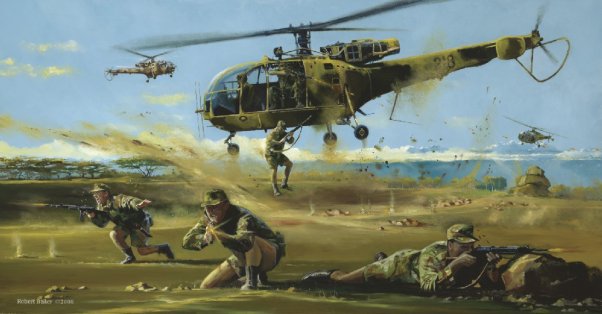
The initial wave of Fire Force troops would board the Alouette helicopters and lift off. Four helicopters carried the point of the spear. The formation consisted of one K-Car and three G-Cars.

The K-Car was the Command and ‘Kill’ car. This served as an aerial command post with a crew of three – Pilot, Gunner/Crew Chief/Tech and the Fire Force Commander.

The G-Cars carried a crew of Pilot and Gunner plus the 4 man stick. The troop carriers were customized by turning the front row seats towards the back. This facilitated a quicker exit of the chopper and allowed a stretcher to be placed on the floor for a casevac.

The K-Car was armed with a 20mm 151/20 auto cannon, which was devastating in the hands of an experienced Gunner. While the G-Cars dropped their Troopers, the K-Car and Fire Force Commander would survey the battlefield and communicate with the Stick Leaders on the ground, directing fire and helping the sticks locate and engage the enemy. Orbiting the battle at around 800 feet, the Gunner was able to use the cannon to kill as well as fix the location of the enemy.

Often, the K-Car would circle the battlefield for several minutes while the FF Commander would assess the terrain, the available troops and the likely movements of the Terrorists. If the Daks and their sticks were available, this gave the Commander more possibilities for sealing up the area.

If the numbers of Terrorists were large and in the open, a call for the Reims-Cessna 337G Lynx to make a bombing run, dropping anti-personnel munitions or napalm was made prior to insertion. The Lynx would stay on station to employ its guns or return to base to re-arm.

Once the FF Commander was able to put together all of the variables he could then act. As the war grew in intensity in the mid to late 1970′s, more men were parachute-qualified. This would prove vital to a successful operation. With the Dakota able to drop up to 20 RLI soldiers out of a single aircraft, it was the preferred option for a large direct sweep, with the G-Car sticks acting as stop groups for the enemy that ran from the K-Car and the Sweep.

In the American Military amongst paratroopers, a combat jump is usually a once in a lifetime or generation event. In the Bush War, it was just part of the job. The ideal static line jump occurred between 400-600 feet. Often times, the altitude was 300 feet or below. This could quickly turn into a totally wrecked sweep line if the pilot made an error, such as the slant of the DZ with the end of the lane rising higher than the beginning. Astoundingly, a RLI soldier holds the official record for Combat Jumps at 73′!

Once the drop was made, the Troopers immediately discarded their parachutes and left them for a tail force, or ‘wanker’ group, to police them up. These men would come in via helicopter or on troop trucks depending on the location. Stick leaders accounted for all of their troops and their condition and then linked up with each other and the K-Car via Radio for instructions.

With the K-Car delivering cannon fire, the Terrorists would often ‘Bombshell’ or scatter away and head for vegetation or any type of cover they could find. A skilled pilot and gunner developed the ability to push the enemy towards the main Sweep line.

By now, the G-Car sticks would be heading to positions awaiting the fleeing men. Zipped up between the K-Car, the oncoming Sweep and stop groups, there were few options left.

In spite of all directions being covered, it was easy to lose sight of men once they entered the bush. In many cases, the original source of intelligence, the Scouts, were still atop their position and would give the FF Commander locations and routes of the quarry.

In constant communication with the Commander, the Sweep would move ahead. A skirmish line was preferred with the ability for each Trooper to have visual contact with the man to his right and left.

It was now up to the boots on the ground to close with the enemy and kill them.

Some of the Terrs would simply run as far and as fast as they could without trying to engage. Many stories have been written about the dry creek bed that the Trooper had been posted to and the fleeing Terr meeting with a quick death in a hail of gunfire. Often at point blank range to ensure that there was no wasting of ammunition.

Three rules the Sweep used to enhance their safety and success were 1) to never sweep up a hill. They would often flank to the top and sweep downwards. 2) never sweep into the sunlight. This was the responsibility of the FF Commander when placing initial sticks. 3) Always sweep from cover into open ground, never from open ground to cover. These were often difficult to adhere to due to the type of terrain in Rhodesia.

Ideally, the Sweep would make contact in a relatively short time, exploiting the confusion and speed with which the attack had come. The enemy were reportedly poor marksmen (one technique taught to the terrorists was to put the AK over the shoulder pointing backwards and run away!).

From a distance, bullets usually cracked over their heads due to the rising propensity of the AK-47 on automatic. Upon contact troopers would either drop to one knee or go prone and begin to employ the marksmanship skills they had drilled into them, scanning for possible cover and drilling their positions.

When they were sure of the location of the incoming fire, they would employ Fire and Movement drills familiar to infantrymen around the world. Depending on the amount of men available and the terrain, the Skirmish line would end up in a complete overrun of the position.

The first F and M would split the men in half with one firing while the other moved forward, leapfrogging their way forward. The second method called for every other man to rush forward while the man next to him covered. The third was called the Pepper Pot. From a prone position, random men would jump up and move forward under cover of the others. This was the most difficult to counter and was most common amongst individual sticks.

If they moved into the bush, the pace would slow and the skill set of snap shooting on the Jungle Walk would be used. Troopers were taught to look through, not at the vegetation. It took a lot of experience to develop an eye for spotting the enemy. Many Terrs who were ill-trained and ill-motivated would simply try to hide, knowing that they were surrounded. Face to Face encounters were not uncommon for the Rhodesian Soldier.

Once the pressure had been put upon those willing to fight, anyone not hiding fled. Stop groups were not always successful at bagging the last left alive, even though the FF Commander was able to orbit the battlefield and move the stop groups to strategic exit routes.

At this point another Elite unit of the Rhodesian Army was brought in: the Tracking Combat Unit. Once ferried in, they would find the spoor of those who made it out and track them down until they were either found or the mission called off.

So determined and keen were these men that one story stands out to the tenacity of the unit. After an escaped Terr fled the scene of a FireForce Mission, for 3 days and 3 nights, the trackers pursued him until the tracks stopped and he was found hiding behind a tree. He was captured and put into criminal proceedings. He protested against the brutality of the Trackers, saying he ‘was hunted down like a dog’!

Once the shooting stopped, the work continued. All bodies were recovered and recorded. Troopers were responsible for dragging the bodies of the men they had just killed into a central area where members of the Special Branch could investigate and look for intelligence. Depending on the size and length of the operation, Call Outs and Contacts could occur up to 3 times in a day.

The rotation of a typical RLI soldier would consist of 6-10 weeks in the bush with two weeks of R&R. Unlike America’s wars of the present and past, Rhodesia was fighting for its home, its literal ground underneath its feet. Should they lose the war, they would no longer exist as a nation.

Motivation was high.

Many Rhodesians served in an ongoing shooting war on its doorsteps for close to two decades and knew nothing except War and Soldiering. After Robert Mugabe took over the nation at the opening of the 1980′s, these exceptional soldiers from the RLI and the SAS and other elite units moved on to provide their experience to South Africa and spend another decade fighting against Communism.

Fire Force is just one example of the Rhodesian’s COIN techniques. Even within Fire Force, there is much more to be researched. Many fine books have been written by Military Historians and by those who served. Two fine books written by the soldiers themselves are Chris Cock’s “FireForce – One Man’s War in the Rhodesian Light Infantry”, and Charlie Warren’s “RLI – Stick Leader.” I also recommend visiting Professor JRT Woods website for more information.

Read more: http://sofrep.com/7798/fire-force-rhodesias-coin-killing-machine-part-3/#ixzz23G0a7me4

Read more: http://sofrep.com/7798/fire-force-rhodesias-coin-killing-machine-part-3/#ixzz23G0Ui2wP

Read more: http://sofrep.com/7798/fire-force-rhodesias-coin-killing-machine-part-3/#ixzz23G0OtEk3

Read more: http://sofrep.com/7798/fire-force-rhodesias-coin-killing-machine-part-3/#ixzz23G0JQXRt