
Subscribe to continue reading
Subscribe to get access to the rest of this post and other subscriber-only content.
Subscribe to get access to the rest of this post and other subscriber-only content.
The U.K.’s Special Air Service needs no introduction to anyone remotely interested in military history or Special Operations. However, there is much more to learn about this elite unit when one traces its existence and influence across the once global British Empire. Much of the power of the Brits was derived from their colonies and their stock of available military recruits. Australia and New Zealand have retained the SAS as the designation of their Special Operations Forces.
After the end of the Second World War, the British government saw no further use for the unit and disbanded it in October 1945. Within a year of that decision, a reversal was made and the SAS was resurrected. They drew soldiers from the Territorial Army and continued training for future conflicts on the horizon. In 1950, Britain committed to helping the UN to stop communist aggression on the Korean Peninsula. After three months of preparation, 21 SAS was given orders to Korea. During this same period, another problem arose in Malaya, which was administered by the British. The problem perfectly suited the Unit’s capabilities.
In 1948, communist guerillas began attacking British infrastructure and challenging British rule. These insurgents were a reconstituted arm of the local units that the British had trained to fight Japanese occupiers in WWII. The terrain and tactics of the guerillas were difficult to counter with conventional forces. Sabotage and hit and run operations began against the transportation system and the lucrative rubber plantations that were vital to Britain. The guerillas would come from the impenetrable jungle and disappear back into it.
The British had learned many valuable lessons in jungle warfare while fighting the Japanese in South East Asia. This training and experience still lived on in the commanders of the Malayan detachment. With forces being committed to the Korean conflict and the need for manpower worldwide, it was decided to make a recruiting drive for men in the colonies to try out for the SAS. So troops were raised to fill A Squadron and B Squadron, mainly from experienced British Territorials who had geared up for wartime deployment to Korea.
These forces would form the Malayan Scouts (the forefathers of the modern SAS) whose primary mission would be reconnaissance and the interdiction of the Communist Terrorists (CTs) along their known supply routes. It was a steep learning curve for the two squadrons and jungle illnesses took a brutal toll.
In 1951, Major “Mad Mike” Calvert, the expedition’s commanding officer, decided to take a trip to the far away African colony of Rhodesia. Rhodesia had contributed greatly in proportion to its population in WWII and a few Rhodesians had served in the SAS. Those younger Rhodesian men, who had felt that they had missed their chance to fight for the Crown due to their youth during the ‘Big One’, applied in droves. This caused quite a stir and the applications were capped at 1,000. These 1,000 applicants were carefully screened and 100, i.e.- the top 10 percent of men were chosen to be a part of the Malayan Scouts and the now resurrected SAS.
Once they were chosen, they underwent basic training and onto the general skills of an SAS Trooper by two Rhodesian veterans of World War Two, Lt. Peter Walls and Lt. Ron Campbell-Morrison. Both were combat experienced and expected to be replaced by a British commander once in-country. With great fanfare and a crowd of 3,000 people in Salisbury, the 100 were sent off to war. Upon arrival in the harsh jungle environment, they were faced with the reality of a hard-bitten counterinsurgency campaign. The Rhodesians would be C Squadron, the unit designation that would unknowingly stick with them far into the future ( now over 70 years for a temporary unit! ).
Their reception was not a welcome one but the men of the established A Squadron made an impression on the Rhodesian recruits. Yet, being highly motivated and unspoiled, they remained hearty and willing to get on with the mission at hand.
As a small, self-contained and isolated unit is often prone to, there were disciplinary problems among A squadron. While the Rhodesians did a six-week workup, discipline was restored among the other men and several of them were sent packing. After the training course in the country, it was decided that the Rhodesians would not be split up nor have a British commander. Peter Walls would command C Squadron for the duration of the deployment. During the ‘yet to come’ Bush War- the existential battle for the life of their beloved Rhodesia – Lt. Walls would later become the Combined Operations Commander for the Rhodesian Army.
The young men had been chosen for their background and ability to work with a team in a harsh environment. Rhodesia was a breeding ground for excellent soldiers. Many of the men had grown up working hard on their family farms, playing Rugby and most importantly, hunting and tracking which developed a sixth sense needed in true Light Infantry combat. Tracking in Africa was an essential skill that could not be learned overnight. They found themselves having to learn to operate in unfamiliar terrain- the jungle instead of an open, sunlit battlespace. In the Rhodesian bush, the sun would light the tracks and give the tracker information by the shadows created. This made it easier to spot spoor, making for a quick assessment and pursuit. Among the men was a youngster by the name of Ron Reid-Daly. His upcoming learning experience would eventually help revolutionize counterinsurgency warfare with the formation of the Selous Scouts in the Bush War.
The canopy of the jungle blocked the sunlight causing the men to look for different spoor than they were accustomed to. The floor of the jungle was full of rotting vegetation and oftentimes the bush was so thick that machetes had to be used to move forward. The vegetation was as much their adversary as the CTs were.
Here, the lessons of Guerilla Warfare and Counter Insurgency, took root in the Rhodesian unit. This war would not allow for the entire squadron to hack through the jungle in open pursuit of the enemy. To do so would invite ambush and death. Small unit tactics were refined to a razor’s edge. Operating in small groups, from a four- to a 14-man patrol was the norm. The conventional doctrine taught that soldiers could operate for a maximum of seven days in the jungle. Yet, the SAS had other plans.
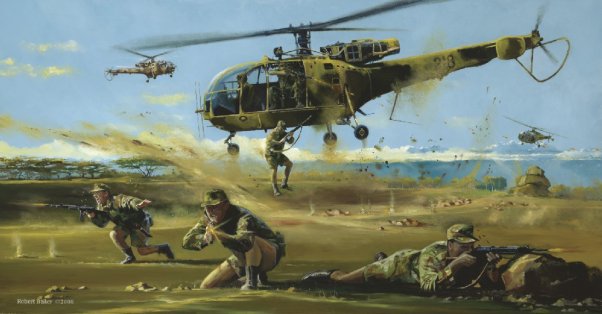
The enemies were not large in number but their native mastery of the jungle allowed them to a lesser jungle experienced army. C Squadron’s job was to locate the CTs, take their safe havens away and destroy their supplies, ambush their trails and avenues of escape and then drive them out of the bush and into the hands of more conventional and heavily armed units. This took patience and resolve. The SAS would often spend weeks at a time tracking and piecing together the intelligence that they developed. The helicopter, a new tactical tool, allowed the men to be inserted deep into enemy-held territory and hunt their prey with the resources they had. Heavy, advanced and technologically superior air assets and pinpoint artillery strikes were rarely, if ever involved. It was mano y mano warfare of wits and skill, from the officer down to the lowly troopie. Every gun ( gat ), every bullet, every step and each recce mattered.
Typically, a team would insert into an area believed to be near to or exactly in the home of a band of CTs and plot out the areas to recon, methodically searching behind every bush for information that would lead them to their objective. A base camp would be set up and from there men would be sent in four distinct directions to create a 360-degree search area. This might go on for days or weeks until they would find a trail or a camp. Once the enemy was located, they would devise an ambush plan. It was rare to make an outright assault due to the small number of operators. Their training in Navigation, Patrolling, Snap Shooting, and Ambush was being implemented with an ever-growing proficiency.
The fresh-faced lads that arrived in 1951 turned into Men of War, Jungle Fighters, and Soldiers of the Elite C Squadron of the SAS. Their reputation as solid SAS men grew among the British. For nearly two years the valiant “100” navigated, patrolled, and battled the Communist Terrs, building not only a reputation of a competent part of the SAS but soldiers to be feared. That experience would pay off in spades and quite frankly helped hold the Rhodesians together many years beyond what it should have against a numerically superior and supplied enemy in the coming decades.
Due to their skill, patience, and fortitude, they returned home in 1953 after nearly two years of combat with only three KIA. For his leadership in a merciless environment, Lt. Walls received the MBE, Member of the Most Excellent Order of the British Empire. More important than any medals or accolades that the British gave them was the fact that a foundation was created that Rhodesia could build an elite unit on par with the rest of the world. The unit was to battle the storm that was on the horizon in an increasingly fiery Communist superpower backed, trained and supplied war for Post-Colonial Africa.
I have officially come out of retirement to share what I have learned in the last decade both historically and as a writer. I have decided to use this website alone to provide a platform for my writing. I’ll be focusing on notable and compelling people and the events surrounding their lives. It should be free for all to read.
If an opportunity arises to share my writing on any other website, journal or unique platform I will send out a not to my growing subscribers.
My last article for SOFREP was fittingly about American Legend Bob ‘Mckenna’ Mackenzie. I was limited to 1000 words but we know that he could fill a book with all of the stories known and unknown, revealed by his friends and fellow soldiers.
https://sofrep.com/news/robert-mackenzie-an-american-soldiers-war-against-communism-in-africa/
I look forward to returning filling up pages of not widely known stories.
Peter Nealen is fast becoming a guaranteed, legitimate writer and analysis on current world conflicts and the ever changing world of the Marine Corps Special Operations endeavors. His hard hitting analysis and history on many Tier One websites is second to none. If he writes it, I know it is reliable. It is a rarity that an author can jump back and forth between HistoJournalism and ball busting fiction with equal effectiveness. But if follows that a man who can conquer the most difficult courses and standards that the Marine Corps has to offer can and will master whatever he chooses to lay his sights on.
I have to admit when first reading the series, I was thrown off by the first person narrative. It’s not often that I have been able to keep my attention or interest in First Person fiction that has a lot of ground to cover. As I kept reading, I unknowingly fell right in as rear security for the Team. This book holds uniqueness among the new wave of military fiction. The flow of the action continues from point to point and ratchets higher and higher.
The operational details, language, down to the dead time an Operator spends fighting an irregular war are second to none. This can only come from a person who has been there and done that more than once. What Nealen is giving us is a glimpse inside the mind of a Tier One Operator under very inhospitable circumstances. No detail is left undone yet it is not in the least cumbersome.
Before you read the American Praetorian Series, you might want to clean the rifle, lace up the boots, check and double check your gear because you will be unsure of where you are after a session of reading. I highly recommend this book and its prequel for people wanting to go to the Sharp End for a new mission. D.R. Tharp Author of Africa Lost: Rhodesia’s COIN Killing Machine and the Task Force Intrepid Series.
Graham Gilmore has given us a very well packaged history of the short lived but highly trained and effective unit in the SADF. The Unit is Legendary among Southern African Wars due to its unique formation and composition. Some of the very top soldiers to ever live, Col.Breytenbach, CSM Peter McAleese, CSM Dennis Croukamp and others concieved, trained and deployed a unique experimental unit to fulfill the need for a specialized troop to recce and coordinate airborne drops of troops. Their selection process in the Drakensburg mountains was as tough as the SAS, SEAL’s, Delta, etc.
One of the most interesting factors of this study is the relationship it had to Rhodesia’s foreign troops from Europe, the UK, Canda, Australia/New Zealand and the US. After the Bush War in Rhodesia was lost through the UK and the US installing Mugabe, the men of Rhodesia’s special forces were disbanded and treated as fugitives. South Africa capitalized on the experienced men and leadership by forming the Pathfinders and funneling others to units in the SADF. However, many traditional Afrikanner staff officers were shocked by the operational methods and discipline of Rhodesia’s soldiers. The foreigners greatly disappointed the rigid culture of officers in the SADF. Col. Breytenbach realized the potential for the unit as he did with the Recce’s and other units.He himself was a Leader. Colonels don’t usually demand they be the vanguard of a unit in the bush seeking contact with the Terrs. Yet this is the type of unit the Pathfinders of Phillistines were.
Like American units in WW2 or Vietnam such as the Marine Corps Raiders, or the LRRP’s, they appeared, shook up traditional doctrine and eventually the bureaucracy won and cut their nose of to spite their face. Yet the stories of the men are stuff of legend and a very unknown unit now is able to be studied from a person who had been there, done that. I highly recommend this book to any person who is interested in Special Operations, whether it be in Africa or Afghanistan. 6 stars . Dan Tharp author of Africa Lost: Rhodesia’s COIN Killing Machine, Task Force Intrepid: The Gold of Katanga- Bravo!
Publishing with St. Martin’s Press under SOFREP.com’s banner, I will release a survey of Rhodesia’s Special Forces and shed some light on a long fogotten subject in Military History. Much more to come in 2013 and 2014!!!

There is a quiet revolution going on in the publishing world. Most of it is by indie writers and publishers who have decided to bring back something for men to read. That’s right R-E-A-D. In our day and age of the Internet, 500 cable channels and endless 24 hour a day news and talk shows it appears that this ancient desire has been funneled into 50 shades of Gray, and other tripe.
This has left out the Men in our society from partaking in the most fruitful of all mental occupations. I wish I had a bumper sticker that said, Sit Down, Shut Up and Read a Book. The NYC literati community decided that it was above putting out good quality Mens Adventure series and killing off one of mens previous favorite past time. Reading a rip roaring Adventure story. You might ask, what mental exercise is it to read a gun and run novel?
There are now a select few who are writing to the educated Man, versed in politics, geography and weaponry at a level not so in the past. Novelists worth their Dime rise to that level. When men of this caliber aren’t reading non fiction or the WSJ, in their down time, they like to read an engaging story up to their level.
Hank Brown is one of these writers who has an affinity for the past at his blog and the New Generation of ‘Dude-Lit’ as he calls it at
http://twofistedblogger.blogspot.com/
His newest novel it Tier Zero that meets up the past with the present. His surviving characters from the gritty Hell and Gone meet up for a ‘one last time’ mission to rescue the daughter of Tommy ScarredWolf from sex traffickers and pirates in the south seas.
Etching in commonalities of the silent majority of men’s men, he crafts a story that moves along at a good pace bringing us to a story that is full of action, intrigue and Shock and Awe. Tier Zero is the best of both ages of Dude-Lit. I highly recommend this book to fans of Men’s Adventure and Military Fiction. While you’re at it scarf up the prequel, Hell and Gone. At 4.99 on your Kindle, you wont be disappointed. D.R. Tharp
Six Blue Helmets stood watch over the main gate of the compound outside of Bukavu. The United Nations compound, a mixture of permanent metal structures, temporary buildings and tents housed 300 soldiers from various countries all under the Blue Banner. Adjacent to one of the few paved roads in the Eastern Congo, it saw a lot of activity.
MONUSCO, the U.N. mission to stabilize the Congo had small base camps across the country with the majority in the East. Started in the late 1990’s, it never ran out of riots and human tragedy to monitor. Its ineffectiveness was a constant point of ridicule worldwide. Its enthusiasm to engage in confronting militias and protecting the civilian population, derided.
The scandals involving the soldiers never ceased. From Ivory trading, Arms Trafficking to the rebels they were there to fight, the smuggling of Gold out of Africa to the horrific allegations of trafficking in underage girls for sexual slavery. Many believed that they were no more than a token effort by the world to establish peace and the rule of law in a place where it could not be achieved. Profits were good for a large number of companies involved in the products of War Fighting.
Manned mostly by third world nations such as Bangladesh, Egypt, India, Pakistan, South Africa and countless others, the soldiers were in a situation that was not that far removed from conditions in their home countries. The motivation to bring peace, prosperity and democracy was skewed when their homes had little more to offer.
The rotation of the gate guards was on time. Six Pakistanis relieved six Egyptians, turning over the log books and demonstrating the readiness of arms for duty. Once the Egyptians had left, the NCO in charge of the gates went into the shack sat down and poured a cup of Chai to help keep him awake for the next 4 hours. A laptop was available and he quickly opened his favorite pages. The Nation, a leading newspaper in Pakistan, his personal Hotmail account and his favorite site..teeniefiles.com, which was updated every day. As a good Muslim, he of course admitted it to no one. Pakistan owned the world record, according to multiple news sites, for searching and viewing pornography on the internet. If his troops didn’t complain, he would allow them fifteen minutes each on the computer.
He opened his Hotmail account and searched through the spam to find a message from his wife. This deployment had been easier than in the past because they had managed to afford a home computer and communicated daily. The email was mostly dry, telling him about her day and her father and mother and their little boy, Hussein. Though housekeeping details were boring, he at least felt in touch.
“Sergeant, can I take a cigarette?” asked one of the soldiers manning a PKM Machine Gun.
“Yes, if you will give me one as well,” he said sheepishly.
“Very well.”
The Sergeant took a sip of his Chai and stood up as the soldier handed him the cigarette and lit it for him. They both inhaled deeply and looked up at the night sky.
“Do you hear that?” The Sergeant asked. The sounds of a helicopter were coming from the east. They had no reports of any incoming aircraft tonight.
“Perhaps it is going to the airport and using the highway as a guide.”
“Let me radio the guard shack at the Helo pad.” After a short communication it was clear that nothing was expected this evening.
Dak-Ho Kwon sat in the cabin of the MI-24 Assault Helicopter. After receiving the all clear from Malouff, the two Russian built helicopters took off and headed across Lake Kivu towards their hard target. Fully armed, including two port and starboard machine guns configured to shoot out of the side windows, they would incapacitate the camp. Anyone left over would be held prisoner.
“Target in sight. Zebra 1, you have the ball,” Kwon heard across his headset. He shouted out to the seven other North Koreans to stand to.
The number two helicopter hooked left to prepare for a south to north gun run. The Command chopper crossed onto land and over the highway that paralleled the giant inland sea. Flaring at 800 meters from the front gate the weapons operator in the nose of the Hind lit up the Yak-B Gatling gun, spitting incendiary rounds into the guard tower and gun emplacements. Three bursts later, none of the guards were moving.
The Pilot hovered while the other made a fiery pass over the camp then circled counter clockwise, allowing the window guns to rip through metal buildings, tents and weapons caches, causing secondary explosions and fire. Through the Night Vision Goggles the weapons operator could see bodies stumbling around and falling. The pilot slid the Hind to the left and right giving the Yak B a chance to traverse the area. After another round or circling, Kwon gave the order.
“Cease Fire!”
The two flying tanks could have done much more damage to the point of leaving it a charred, lifeless pit but that wasn’t the plan. As the blackened up North Korean commandos inside the helicopters had rehearsed, they were set down on the north and south side of the camp and began to sweep with the Hinds hovering overhead, collecting what was left of the Blue Helmets.
I would like to let readers know that I have released an interview with Michael Watson a former member of the Greys Scouts, a horseback light infantry unit in the Rhodesian Bush War. It is not a very well known unit but deserves attention by military historians. Thank you to Mr. Watson and the best of luck with his future endeavors on writing his compilation and hopefully, we can get some more info up on SOFREP.com about specific dust ups and ops.
Please read and post it on your facebook, twitter, etc.
http://sofrep.com/15456/greys-scouts-interview/
 The Sharp End of the Spear