Greetings! I came across this post on Facebook. I’m not completely sure of it’s origins-I’d like to give credit to the Author of the book it came out of. If I find out, I’ll amend this entry.
The passage below describes what many believed to be the beginning of the serious battle for Rhodesia. Alot of observations about the coming war can be extrapolated. I add commentary of the things that stood out to me from a historical perspective. If you are not familiar with the Rhodesian Bush War, it is a good introduction to what kicked off larger scale military operations against the Communists Insurgents / Terrorists.
——————————————————————————————————————————
The attack on Altena Farm occurred in the early hours of 21 December 1972, during the third phase of the Rhodesian Bush War. Altena was a tobacco farm owned by Marc de Borchgrave. Rhodesian intelligence, which had been monitoring ZANLA’s activity and preparations, grew curious when over a four-week period in November 1972 sources of information suddenly began to “dry up”, in the words of historian Alexandre Binda. “They sensed that something was afoot, but their superiors brushed off their fears,”
On the 21st December 1972 a group of ten ZANLA cadres led by Rex Nhongo attacked the white-owned Altena Farm near the north-eastern village of Centenary. Having established a presence in the nearby Chiweshe Tribal Trust Territory, a cadre of Zimbabwe African National Liberation Army (ZANLA) insurgents armed with AK-47s, hand grenades, and at least one light machine gun (most likely an RPD) trekked about six miles to reach Altena. Around three o’clock that morning, the guerrillas cut the telephone lines and laid a land mine in the driveway.
Nhongo undertook a reconnaissance of the farmhouse before the attack commenced. Each insurgent then expended at least two magazines of ammunition apiece at the structure. Hand grenades were also thrown, yet despite the damage caused to the structure, only de Borchgrave’s eight-year-old daughter Jane was injured.
Late on the 22 December, a troop from the Rhodesian Special Air Service, followed shortly by the Rhodesian Light Infantry, reported to the police station in Centenary. The land mine planted in Altena’s driveway was discovered, disarmed and removed. Borchgrave and his family were sent to Whistlefield Farm, which was owned by Archie Dalgleish and his family while their family home was being repaired. Having been alerted to the de Borchgraves’ new location through sympathetic farmworkers, guerrillas from the original cadre requested permission from ZANLA to carry out another attack. After ZANLA’s area commanders in Centenary had been consulted, a raid on Whistlefield Farm was planned.
At about one o’clock on the morning of 23 December, the insurgents reconnoitred Whistlefield Farm and shelled the structure with mortar fire. An RPG-7 was aimed into the bedroom in which de Borchgrave was sleeping. The rocket hit the window frame and lightly wounded the tobacco farmer, his nine-year-old daughter Anne, and de Borchgrave. The ZANLA cadres then retreated and hid themselves.
News of the second attack reached Second Lieutenant Ian Buttenshaw and Sachse around midnight, and they deployed immediately, but having discovered a mine near Altena they disembarked from the vehicles 1 kilometre from Whistlefield and made the final approach on foot. Anne was evacuated by helicopter as the RLI and SAS secured the area for the night.
The next morning, on 24 December 1972, two tracking teams arrived at Whistlefield to assist Buttenshaw and Sachse in a 360-degree search: one was from the SAS, and led by Ron Marillier, while the other was a British South Africa Police (BSAP) team including tracking dogs. The security forces searched for tracks while also investigating reported sightings.
The tracks of the ZANLA fighters were discovered on 27 December on the western side of the farm and the trackers asked Buttenshaw and Sachse to bring the vehicles carrying the heavy equipment around to meet them. On the way the truck carrying Buttenshaw ran over a mine with one of its rear wheels, causing it to detonate. Buttenshaw himself, who was sitting on the bonnet of the vehicle, was thrown clear but Corporal Norman Moore and Trooper Pete Botha, sitting in the back, were not as fortunate, taking the brunt of the blast. Captain Gordon Holloway, behind the wheel, and Trooper Rod Boden in the passenger seat went into severe shock but were ultimately unharmed. Moore, on the other hand, died two days later from his wounds, while Botha survived but lost both legs.
In their haste, Nhongo’s cadres had not attempted to conceal their tracks as they headed west, towards the Musengezi river—Buttenshaw’s pursuant RLI men therefore realised how quickly the guerrillas were moving and sped up their chase. They discovered a recently vacated guerrilla camp. “The fire was still burning and the food still warm,” Buttenshaw writes. “From the abandoned kit a hurried departure appeared evident.”
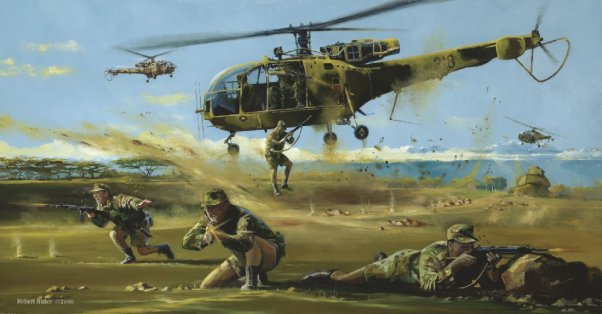
Support was summoned from the SAS, who were tasked to set up stops along the Musengezi to the west. Buttenshaw’s men reached the top of the Musengezi valley to see Rhodesian helicopters dropping the SAS soldiers at regular intervals along the river, as well as the ZANLA cadres, who were moving straight towards one of the SAS stops. The stop opened fire and killed some; the rest of the guerrillas scattered and ran. Buttenshaw’s RLI men were then withdrawn from the follow-up for a day and a half and placed in stop positions. The chase was temporarily taken over by the SAS under Lieutenant Chris Schulenburg before Buttenshaw’s men returned on 30 December 1972.
For the first time the Rhodesian Security Forces were faced with a seemingly insoluble problem … after carrying out their attacks the terrorists had not gone to ground in bush-camps in uninhabited areas where they could eventually be tracked down … neither had they gone to ground in inhabited areas where information from the local population to the Police or Special Branch had indicated their whereabouts.
This time there was nothing. No tracks … no information. Lieutenant-Colonel Ron Reid-Daly, writing in 1982, explains the effect of ZANLA’s subversion on rural Rhodesia. The effectiveness of ZANLA’s adopted Maoist tactics was demonstrated in particular by the element of surprise they were now able to use against the security forces, and by the ability they had achieved to melt seamlessly into the local population between strikes.
The rural black people in the north-east of the country were now, almost totally subverted and intimidated” by ZANLA and provided the guerrillas with food, shelter and manpower. Rather than having the tribesmen actively volunteer information about insurgent movements and locations, as had happened during previous infiltrations, the Rhodesian Security Forces now met an increasingly silent and sometimes hostile welcome from the rural blacks.
More farm attacks took place over the following weeks, during December 1972 and January 1973, leading the security forces to set up Operation Hurricane in northern Mashonaland. This counter-insurgency operation would continue right up to 1980. “It was the start of a whole new ball game,” writes Lieutenant-Colonel R. E. H. Lockley. “The war proper had started.
- This article, as I stated was taken from a forum on Facebook.
- It is interesting for many reasons. Rhodesia had dealt with other incursions of the now blatantly violent Chinese trained and backed ZANU party which would eventually be led by Robert Mugabe. It involves the Terr leader Rex Nhongo who should have been dead many times over, one time being in the sights of a SAS operator operating with Darrell Watt but the fleeing man had no weapon in hand. The discipline of the SAS soldier and the ethics they operated by were not to shoot and kill a person they were not completely certain was a belligerent and could be simply a scared villager.
- The Maoist Doctrine of melding into the people rather than operating from fixed positions where they would be located made it difficult to track down the perpetrators of these types of attacks. Note-later in the war, as the war progressed ZANLA and ZIPRA did have camps which made it easier to take out large swathes of Communist Terrorists.
- It gave birth and realization to the RSF’s need for internal intelligence through INTAF ( Internal Affairs, a force that looked after the native population ) and the BSAP ( the British South African Police ) , the National Police Force.
- It became necessary for all of the forces of Rhodesia including the Army to get involved and find ways to track down Terrorists before they carried out attacks. Operation Area Hurricane was opened in the North Eastern part of Rhodesia which remained a very active route of infiltration until the end of the war.
- Events like this started the minds of people like Lt. Col. Ron Reid-Daly to come up with ways of infiltrating the indigenous people and gain intelligence and gave birth to the famed Selous Scouts, masters of Psuedo Operations.
- Finally, with this string of military grade attacks, Rhodesia had to put itself officially on a war footing if they were to save the country and protect its people.