An Absolute Masterpiece of the Era of the Professional Adventurer and Soldier….Plainly Stated….THE BLEED

Several years ago while reading the writings of Robin Moore, the author of the classic book The Green Berets, I discovered that he had spent two years in Rhodesia, a small African country, running an unofficial American embassy that catered particularly to Americans who had joined the Rhodesian Army in their battle against the tide of Communism in Southern Africa.

I began to remember old Soldier of Fortune Magazines that had written about ‘Mercs’ fighting for this country. Needless to say, I was intrigued and wondered who these men were, these ‘The Crippled Eagles’.

I scoured the internet and Amazon to find any reading material that would give me more information on these men. Most of whom were veterans of the Vietnam War that continued the profession of War Time soldiering and the battle against the Red Tide. Very little was available at that time. Thankfully, I found bits and pieces that would lead me on to another clue, another person to contact or another book to read.

Book Review: The Bleed by John Cronin

It seemed that these men were quiet. The ones who were very loud and vocal, adding Mercenary/Rhodesia/Selous Scouts to their CV were often frauds. It was easy even five years ago to imagine your past and add in some manly ‘Merc’ activity to it, simply because resource material was scarce to verify a persons claims.

As I began to home in on legitimate pieces of information, certain names kept appearing and John Cronin was one of them. I keep a list of people that I hope to come across in order to possibly get their stories or information on the war. It turned out that the best information came from the burgeoning online community of Rhodesian War veterans. Their history and story is an understudied segment of military history that deserves to be up there with any of the great Special Operations units of the world.

Some I made contact with on Facebook, others through email. The Rhodesians themselves had opinions on Yanks who made it over to participate in the war. There were either good men or shitbags. Most of the Yanks who went over either excelled as members of the Rhodesian Army or deserted. There may have been 300 or so that went over but far less distinguished themselves. John Cronin is solid.


The Tempestuous Travels of an American Cold Warrior

The search for Captain Cronin had turned up a dry hole so I was extremely excited to see a book simply appear on Amazon’s recommendations for my account. Called The Bleed, I immediately downloaded it and devoured it. This book is a classic autobiography that fills in so many missing links about the few that served in Vietnam and then Rhodesia. Whether you are interested in Rhodesia or not, anyone remotely interested in Special Operations and the lifestyle of a Professional Soldier from the Baby Boom generation will enjoy this read.

Cronin’s family had served with distinction in combat through all of the major wars America has participated in and he was to be no exception. In the mid 1960s and the ramping up of forces in Vietnam, he enrolled at the Virginia Military Institute for his college education. Circumstance and his easy going style forced him to make other decisions a year later.

Not wanting to come back from the Vietnam War in a body bag, he weighed his options and enlisted in the Marine Corps because he felt at that time they were a more motivated, well trained force. Anyone who joined the military in 1966 knew that they were most likely to spend a year abroad in Vietnam, backpack and all. The Author describes a classic path through Marine Corps boot camp ending up with orders to become a radio man. Unlike today, people rarely chose their career path. Dutifully completing the school, he had no intention of sitting behind a desk for the 13 month tour of duty.

Vietnam is full of stories of chance and circumstance of people simply raising their hand and ending up in units that today would require an extremely long selection and pipeline to enter into. 1st Marine Battalion Recon had an opening and off he went. Arriving at the unit, again he finds a way into the bush, and starts operating with elite Marines in the thick of the action along the DMZ.

After a few months of extended recces and surprise contacts with the NVA and VC, the odds caught up with him and he was badly wounded. The author’s humor and perspective come through along with detailed and gripping action. Extracted off the battlefield, he enters recovery, assessing his future. Most would have taken the Purple Heart and finished their time and went back to normal life, figuring that they had done their bit.

After a battle with bureaucracy he made it back and this time he raised his hand for 3rd Force Recon doing God’s work along the DMZ. Quite frankly, with the material that Captain Cronin presented to this point is enough for a book in and of itself. After leaving the Marines, he finished college and felt the desire to gain a commission back in the Corps. His tour of duty as an Infantry Officer in a post-Vietnam era was uneventful, except of course for his love life, which adds to the narrative wherever he went, but it prepared him for the next war that he would choose to fight.

Deciding to test himself further as a Warrior he heads for Rhodesia with a one way ticket and is whisked away to recruiters who examine his history and welcome him aboard. This was a time when Rhodesia was in serious need of manpower. They gave him the choice of either the Rhodesian Light Infantry or the SAS, and he chose the RLI. I personally questioned the Author as to why he made this choice over the SAS, given his Force Recon experience. Trained as an Infantry Officer, he felt that he wanted to utilize his training and meet the enemy in head to head action but he would eventually finish his service in Rhodesia as one of five Americans to have served in the Selous Scouts.

Given a slot straightway into the RLI, he goes about proving himself as a capable officer and tells the story from a unique perspective. He pulls no punches on Rhodesian politics as well as the ‘Freedom Fighters’ of ZANU and ZIPRA. Woven into this time in the RLI is his relationship with a female member of the Army and it is an interesting story of two people living and fighting a war and how it affected their lives.

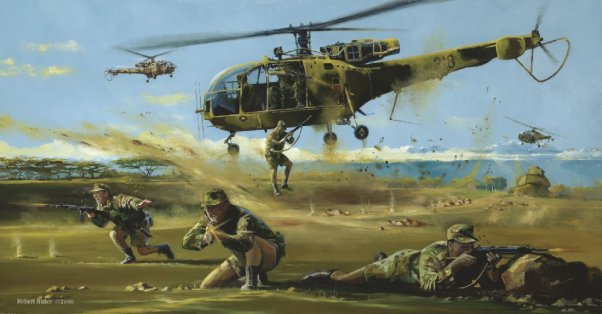
Cronin’s reputation and skill as a RLI Officer is solid as verified by many Rhodesians I have spoken to. His abilities as an Officer grew within the Rhodesian way of war to the point that he was running Fire Force mission from the sky in the K-Car. Anything less than competency would lead to disgrace and duty elsewhere, likely in the mess hall or an adjutant to a motor pool officer of higher rankl

One last thing remained on his bucket list as a Professional Soldier. The Selous Scouts. Known worldwide as one of the most effective counter insurgency forces in history, it is a challenge that he cannot live without. This reader’s understanding of the Scouts was enhanced by reading these chapters.

As Mugabe took power, John Cronin at the age of 32 decided to move on with his life. His interest in foreign affairs, the Middle East and Africa in particular, caused him to pursue graduate studies. Most of us would try to compete for places in the Ivy League schools of the US and perhaps make trips to our region of interest.

Not so for the Author.

He heads for the American University in Cairo and then for study in Beirut, Lebanon. Yes, that place where there was a civil war going on and hundreds of Marines were blown up in one of America’s first tastes of terrorism. As a blonde haired American in a city that hated the West, he was bound for trouble in the form of a kidnapping by Hezbollah. It is harrowing and unhinged but Captain Cronin obviously lived to tell about it – barely.

As a student of the Marine Corps in Vietnam and the Rhodesian Bush War, I found a book that linked them together in a narrative that I have found nowhere else. The Americans who did this are very few in number. Some never made it home and others are nowhere to be found. It’s not just the subject matter that makes this book worth reading; it is the Author’s ability to bring you along for the adventure that causes me to write a review for all readers of SOFREP and military history. It saves us from the pretense that a man of his experience might throw at a reader.

This book is worth far more than the 4.99 I paid for it. In fact, as a researcher, it is priceless. The genuine genius behind it is that you need not be historically ‘informed’ nor even be interested in the wars that are covered. This is the Odyssey of a Professional Soldier in the 20th Century.

Do yourself or someone you know favor by reading this important story ! Then by all means share your thoughts and comments as all are appreciated. To thine own self be TRUE! All the Best!
https://a.co/d/agG4LFr

Hunting in the Shadows Book Review

Peter Nealen  is fast becoming a guaranteed, legitimate writer and analysis on current world conflicts and the ever changing world of the Marine Corps Special Operations endeavors. His hard hitting analysis and history on many Tier One websites is second to none. If he writes it, I know it is reliable.  It is a rarity that an author can jump back and forth between HistoJournalism and ball busting fiction with equal effectiveness. But if follows that a man who can conquer the most difficult courses and standards that the Marine Corps has to offer can and will master whatever he chooses to lay his sights on.

I have to admit when first reading the series, I was thrown off by the first person narrative. It’s not often that I have been able to keep my attention or interest in First Person fiction that has a lot of ground to cover. As I kept reading, I unknowingly fell right in as rear security for the Team. This book holds uniqueness among the new wave of military fiction. The flow of the action continues from point to point and ratchets higher and higher.

The operational details, language, down to the dead time an Operator spends fighting an irregular war are second to none. This can only come from a person who has been there and done that more than once. What Nealen is giving us is a glimpse inside the mind of a Tier One Operator under very inhospitable circumstances. No detail is left undone yet it is not in the least cumbersome.

Before you read the American Praetorian Series, you might want to clean the rifle, lace up the boots, check and double check your gear because you will be unsure of where you are after a session of reading.  I highly recommend this book and its prequel for people wanting to go to the Sharp End for a new mission.  D.R. Tharp Author of Africa Lost: Rhodesia’s COIN Killing Machine and the Task Force Intrepid Series.

Pathfinder Company: 44 Parachute Brigade-‘The Philistines’ Book Review!!!

Graham Gilmore has given us a very well packaged history of the short lived but highly trained and effective unit in the SADF. The Unit is Legendary among Southern African Wars due to its unique formation and composition. Some of the very top soldiers to ever live, Col.Breytenbach, CSM Peter McAleese, CSM Dennis Croukamp and others concieved, trained and deployed a unique experimental unit to fulfill the need for a specialized troop to recce and coordinate airborne drops of troops. Their selection process in the Drakensburg mountains was as tough as the SAS, SEAL’s, Delta, etc.

One of the most interesting factors of this study is the relationship it had to Rhodesia’s foreign troops from Europe, the UK, Canda, Australia/New Zealand and the US. After the Bush War in Rhodesia was lost through the UK and the US installing Mugabe, the men of Rhodesia’s special forces were disbanded and treated as fugitives. South Africa capitalized on the experienced men and leadership by forming the Pathfinders and funneling others to units in the SADF. However, many traditional Afrikanner staff officers were shocked by the operational methods and discipline of Rhodesia’s soldiers. The foreigners greatly disappointed the rigid culture of officers in the SADF. Col. Breytenbach realized the potential for the unit as he did with the Recce’s and other units.He himself was a Leader. Colonels don’t usually demand they be the vanguard of a unit in the bush seeking contact with the Terrs. Yet this is the type of unit the Pathfinders of Phillistines were.

Like American units in WW2 or Vietnam such as the Marine Corps Raiders, or the LRRP’s, they appeared, shook up traditional doctrine and eventually the bureaucracy won and cut their nose of to spite their face. Yet the stories of the men are stuff of legend and a very unknown unit now is able to be studied from a person who had been there, done that. I highly recommend this book to any person who is interested in Special Operations, whether it be in Africa or Afghanistan. 6 stars . Dan Tharp author of Africa Lost: Rhodesia’s COIN Killing Machine, Task Force Intrepid: The Gold of Katanga- Bravo!

http://www.amazon.com/Pathfinder-Company-Brigade–Philistines-ebook/dp/B008BLQK1S/ref=sr_1_1?s=books&ie=UTF8&qid=1379871161&sr=1-1&keywords=graham+gillmore


Tier Zero by Hank Brown

There is a quiet revolution going on in the publishing world. Most of it is by indie writers and publishers who have decided to bring back something for men to read. That’s right R-E-A-D. In our day and age of the Internet, 500 cable channels and endless 24 hour a day news and talk shows it appears that this ancient desire has been funneled into 50 shades of Gray, and other tripe.

This has left out the Men in our society from partaking in the most fruitful of all mental occupations. I wish I had a bumper sticker that said, Sit Down, Shut Up and Read a Book. The NYC literati community decided that it was above putting out good quality Mens Adventure series and killing off one of mens previous favorite past time. Reading a rip roaring Adventure story. You might ask, what mental exercise is it to read a gun and run novel?

There are now a select few who are writing to the educated Man, versed in politics, geography and weaponry at a level not so in the past. Novelists worth their Dime rise to that level. When men of this caliber aren’t reading non fiction or the WSJ, in their down time, they like to read an engaging story up to their level.

Hank Brown is one of these writers who has an affinity for the past at his blog and the New Generation of ‘Dude-Lit’ as he calls it at

http://twofistedblogger.blogspot.com/

His newest novel it Tier Zero that meets up the past with the present. His surviving characters from the gritty Hell and Gone meet up for a ‘one last time’  mission to rescue the daughter of Tommy ScarredWolf from sex traffickers and pirates in the south seas.

Etching in commonalities of the silent majority of men’s men, he crafts a story that moves along at a good pace bringing us to a story that is full of action, intrigue and Shock and Awe. Tier Zero is the best of both ages of Dude-Lit. I highly recommend this book to fans of Men’s Adventure and Military Fiction. While you’re at it scarf up the prequel, Hell and Gone.  At 4.99 on your Kindle, you wont be disappointed. D.R. Tharp


Shadows in the Sand a book review

I picked up this book after eyeing for several months. It dealt with the little known and much maligned Police Counter Insurgency Unit called Koevoet or Crowbar in Afrikaans.Very few books have been written by members of the unit and this is the only one that was written by a black member of the unit. The topic of the Border War in South Africa is a complex matter. Many will use it as a battering ram on Apartheid and can think no further. Viewed in its proper context, the wars in Rhodesia and South Africa were wars against Communism.

The war against Communism to the American psyche was fought in Vietnam in a Hot Fashion and then during the Reagan years through proxy wars and direct political challenges culminating in the dismantling of the Berlin Wall. Little known or cared about is that during the years between the end of Vietnam and Berlin, Russia, Cuba and East Germany were pushing across the continent of Africa, using the guise of nationalism and post-colonial fury to take hold of African resources.

After the fall of Rhodesia, the last holdout was South Africa. Much like America and Rhodesia in the beginning of their Bush War, terrorists inside their borders were considered a police matter. It was not to be a military matter. In South West Africa, now Namibia, the forces of SWAPO and PLAN began to drive down closer to home for the South Africans. Since it was considered a police matter, they began to operate against a well armed and trained foe. The policemen were severely outgunned and outmanned. A specialized unit was needed, much like Americans realized that there was a need for SWAT teams to deal with situations beyond the local patrol and drunk tank in Mayberry.

Koevoet members were drawn from the police ranks, both black and white and were trained by the military to learn to fight a COIN campaign. They adopted tactics and weaponry to fit the terrain of the border area of Angola/Namibia. Perhaps their greatest tool and the key to their success were their trackers. Men of the bush their whole lives, Ovambo, Kavango and other tribesmen who tracked animals for their livelihood were taken in and gave an advantage to Koevoet. Enter Sisingi Kamongo, a young man who looked after his families cattle daily, following their tracks.

Sisingi gives us the insight into the mentality of the time and that of his people that we have yet to hear. He describes his peaceful life in the bush until the coming of SWAPO. They kidnapped, stole, shot, murdered and took cattle away from families. Something had to be done. The people went tothe police for help. Things intensified. As he saw his world collapsing around him due to Communist thugs, the idea of becoming a policeman was a simple decision. He states that he was later called an Apartheid Policeman. Living in the bush, he was quite unaware that 3000 km’s away the politicians dictated a law that separated the whites and blacks and gave preference to whites. None of this was a concern to him because he was a Kavango and they were being savaged.

The Police and Koevoet were, to him, protectors of the peace and of the people of the borderlands. He did not have the luxury of sitting in an ivory tower and debating the politics and morality of a set of laws that most people could not even read. For six years, Sisingi fought as a soldier against Communism and ‘soldiers’ that were anything but and were cold blooded terrorists.

His descriptions of combat are blunt and forthright. He believes he has no need for remorse or to ruminate on the goings on in Pretoria. He does, later on come to realize that Apartheid did have an effect on others besides himself but regarding his own war with Koevoet, he writes as a proud man who did what was right and deconstructs many accusations against the unit and quite frankly makes sense. This is no blind and dumb piece of literature. He addresses the rumors of killing prisoners and other issues within Koevoet but this story is a unique insight into the simple way he saw the war. Its simplicity also drives the thinking man into the bigger questions and the complexity of war and politics.

Rather than cast dispersions on a whole unit or a whole country, this book is part of the puzzle of learning about the Border War and one of the units pressed into action against the backdrop of world history.

http://www.amazon.com/Shadows-Sand-Koevoet-Trackers-Insurgency/dp/0620474793/ref=sr_1_1?ie=UTF8&qid=1347042264&sr=8-1&keywords=shadows+in+the+sand

Book Review for ‘Hell and Gone’ by Henry Brown

I had this book on my ‘must read’ list for awhile. I should have read it earlier. I read it in 3 sittings and it went by extremely fast. I really love the characterization in this book. Anyone who has served in the military will be jolted back to the service by reading the cast’s resume and the way they do things. Even if you never served in Combat Arms, the people are the same. They range from Solid Officers who aren’t afraid of work to the bitter angry socio paths who try and maneuver their way through 20 years and along the way they try and screw Anyone and everyone they can. Obviously, the author has been there and done that. 

At first, I thought the plot to be a typical hadji hunt. The author has done a great job at assembling a mission that you might find anywhere and drags you into the depth of the characters. God, The Flag and American Pie, this is not. And I love it. The sequence of events in the last 2/3’s of the book are extremely unique. I won’t give away the plot of the book as it has been discussed above. Mr. Brown has a talent that I wish he would put to more novels of the military adventure class. This book is worth the time and price and then some. Do yourself a favor and spend the time getting to know the characters of this book. Bravo! Dan Tharp-Author of Task Force Intrepid: The Gold of Katana and Highway to Hell 

http://www.amazon.com/gp/product/B003TU2IY4/ref=cm_cr_mts_prod_img

Like ·  · 2 minutes ago ·