Four Ball, One Tracer: An interview with Author and Professional Soldier Roelf Van Heerden

Originally published on SOFREP.com


The continent of Africa in the 1990s was a cauldron of warlords, failed states, and genocide. From the Rwandan genocide in the east to the decades-long civil war in Angola in the west, to the changes in post-apartheid government of South Africa, people were dying, dictators oppressed their own people, and the continent cried out for solutions.

The world’s first reaction was to send in the blue helmets of the United Nations, which normally brought a trail of bureaucracy, illicit trade, and impotency. Opportunists of all sorts, from arms manufacturers to dealers in blood diamonds, sought to profit off the immoral killing and plundering of the common villager. Instability reigned supreme.

Those soldiers and militaries from the U.N. fared poorly in their attempts to intervene and advise in these conflict zones, much less to “keep the peace.” Those soldiers from the nation of South Africa who had come through 20-plus years of fighting in familiar terrain and climate conditions, and against familiar hostile combatants, knew that to bring certain conflicts under control required African soldiers.


Enter Executive Outcomes. EO has come to represent nearly everything both good and bad about private military companies. Yet the true story is known by very few. Many journalists still mistakenly believe and print that it still exists. Other charlatans with no association with the PMC have used the name to start businesses or claimed to have worked in the conflicts associated with EO, attempting to gain employment or company contracts.

Eeben Barlow has published a book chronicling EO’s inception, contracts, and closure in his book “Against All Odds.” He tells the story from the founder and CEO’s position. It is a fascinating true story. Movies have been made, novels published, and recently, even a graphic novel has been published claiming to tell their story. Colonel (ret.) Roelf Van Heerden takes us inside the operations in Angola and Sierra Leone in his book “Four Ball One Tracer: Commanding Executive Outcomes in Angola and Sierra Leone.”

Colonel Van Heerden has soldiered for more than 40 years on the continent of Africa. In his book, he takes us through his military history and quickly paces us into the recruitment, clandestine travel, and initial landings in Angola through to EO’s final mission dismantling the RUF.

International powers that be and the U.N. were afraid of EO’s incredible performance with a minimum of personnel, equipment, and time. They put pressure on Sierra Leone and other countries to end any associations or contracts with Executive Outcomes using threats and intimidation to end world support for embattled nations. There would be no monetary loans or military assistance if they continued to allow these ‘white mercenaries’ to work and protect their nations.

Colonel Van Heerden was gracious enough to allow me to interview him about his long and storied career, which continues on today: He’s now working counter-piracy missions around the Horn of Africa. He commanded the effective release of the crew of ICEBERG 1 after 32 months of captivity, and he continues his work ‘somewhere’ in that part of the world. For more on his life story, check out his book, “Four Ball One Tracer” (it is available on Amazon in paper or a very affordable Kindle edition). Whether you are a serious student of irregular warfare in Africa or simply want to understand how the first modern private military company operated and won conflicts, this book is without equal.

He tells his story without apologies, fanfare, or any hint of vain glory as the ground commander leading his troops into battle against some of Africa’s most heinous combatants. Invest your time in this fascinating story.


SOFREP: Colonel Van Heerden, you have written the book “Four Ball One Tracer” about your time with Executive Outcomes in Angola and Sierra Leone. You began with EO as a platoon sergeant in spite of having been a full colonel in the South African Army. Can you describe your experience in the SADF?

VH: As stated in my book, I have had a stock standard military life. From both my parents I have military grandfathers and uncles who have fought on both sides of the fence, either for or against the British (Anglo-Boer War) and in WWI and WWII. One of my uncles was a fighter pilot for the RAF and was shot down three weeks prior to the end of the war by young German soldiers operating an AA gun.

Having done 12 months of National Service training, I tried my hand at mining engineering on the gold fields of South Africa, but found it to be boring and went back to join the permanent force (SADF) in 1978.

As a young servicemen at the Officers’ Training College in Heidelberg, South Africa, I was fortunate to become an officer, and I was posted to Walvis Bay in Namibia for the remainder of my National Service period. I did like the synergy found amongst young officers, and that drove me for the rest of my life.

As an officer in SWATF (South West African Territorial Forces), I was driven by the passion of closing the gap between the level officers used to have and the troops by joining them as far as I was permitted. I made it my duty to go on patrol with my troops and battle with the enemy the way the ground troops used to experience this. My four years at 102 Battalion with the Himba tribe in the Kaokoland was a very pleasant experience. This period gave me a considerable advantage in working with different cultures, which was one of the elements of my success in working in Africa. I understood their mentality and learned to use it to the full capacity.

The following military experiences (as a mechanized infantry soldier) gave me a further benchmark to lean on in the years to come, with specific mentioning of Angola. As the staff officer operations (SO-ops) at 82 Mechanized Brigade, I obtained valuable knowledge in planning and commanding armored battalions. This phase of conventional warfare was peaked with the Staff Officers Course at Army College in Pretoria.

During my last few years in the SADF, I served with the CCB (Civil Co-Operation Bureau) and with DCC (Directorate Covert Collection)—both very sensitive and politically orientated and steered. The CCB was part of the special forces under the Chief of Defense Force, and the DCC was a directorate under Chief Staff Intelligence. In both cases I was extremely fortunate in being part of those teams, and that rounded off my illustrious military career.

Soon afterward, I was part and parcel of a “selling-off” program in reducing the covert abilities of the SADF. During the above years as a (PF) permanent force officer, I had numerous battles with the then enemy (SWAPO) in both the unconventional and conventional forces.

SOFREP: Once operations against UNITA began to come together, especially after the initial operation in Soyo, a lot of men went home on a plane. Do you think people were misinformed about their jobs awaiting them, or did experience in combat have a lot to do with who stayed and who went?

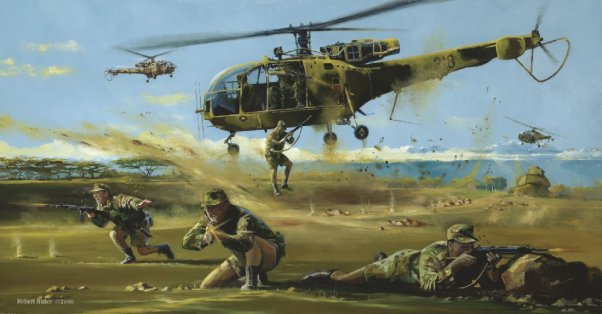
VH: Like with this type of security contract work, there are always misunderstandings about what the work entails. “When the going get tough, the tough get going,” the saying goes. But I have to mention the following: We were all in the picture from the start (we had a cover story, but at some stage, reality also starts in), but the Soyo operation was and still is “madness.” A typical heli-born operation turned into full-scale conventional (staying in the trenches) operation with a high rate of casualties, turning it into hell. For some of the chaps, this was not the way they really wanted to continue, with specific reference to the way we were supported by the FAA (Forças Armadas Angolanas). In Africa, they would rather run away, hopefully to come back tomorrow. This would have left us with ourselves. The “escape” plan was straightforward: Swim for your life until you reach one of the floating buoys in the sea.

Yes, the most experienced were staying behind.

Roelf and Brigadier General Pepe de Castro in consultation prioer to an attack on Cafunfu, Angola.

SOFREP: People often get a misconception about larger-than-life historical events. EO suffered some losses early on. Some of your former recces were a part of a rapid deployment force and were lost or wounded in early harassment contacts. Were there any other lessons for the young company apart from that?

VH: Yes, we soon learned that the best way to support your men is to remain as a “non-integrated force” and fight on your own axis of advance. This is not possible at all times, but plan toward that. Yes, train the host force to become better soldiers, but first win the fight—at least that was what needed to be done at Soyo.

SOFREP: Another misconception among readers is that you as a PMC fought all of these battles against UNITA and the RUF alone. You trained and worked with existing armies in these countries, correct?

VH: You must read this question with the previous one. Remember, there is a difference in culture in battles, and it is not possible to throw them together on one axis of advance. If you have time at hand, you can train them to do these in conjunction, but it remains a very difficult task. In Angola, I and Brig. Gen. Pepe De Castro had differences, but eventually we took turns at leading the battle. This brought about a healthy competition among fighting groups. This method needs proper commanding and good officers.

In Sierra Leone we kept the different, non-integrated ways of fighting. Although we trained them for months on end and had some battles as a joint force, we preferred to keep separated forces. Here, we were doing mainly heli-ops and using support weapons in the support role. Indirect fire was not part of the wars we experienced in Sierra Leone, and we kept that close to our chest.

The same went for the pilots flying in our battles. The SADF pilots were among the finest in the world, and our culture of using helicopters in the close support role was unique to our needs.

SOFREP: Even though you worked as advisors and trainers, you were up on line with the troops you trained. You mention that, in the SADF, being in the rear instead of in among your men was frowned upon. Can you expand on that?

VH: Yes, during my battles in both Angola and Sierra Leone, I found it to be best in being very close to the front troops. If you don’t lead, being up front, your chances are less for making progress. However, this is extremely dangerous: You are more likely to go home in a bag. This is how we had early losses at Soyo. Our men had been caught in a crossfire from own troops and the Angolans (FAA ) from behind.

SOFREP: Once you gained an objective such as a town, you engaged the locals and let them know you were here to set things right. How important do you think that was?

VH: From the start, we made them part of the plan. Secondly, they know the area, and by using them, we gained early successes.

SOFREP: Given your constraints, including manpower and equipment, do you believe that new tactics and strategy were developed during these campaigns?

VH: Yes, operating in different countries with totally different climates and terrain, you very quickly have to look at what is the best method of reaching the tactical objectives.

SOFREP: You have not written about your work after Executive Outcomes, but I understand you have done work near the Horn of Africa?

VH: Yes, I had been the operations manager at PMPF. (The Puntland Maritime Police Force.)

SOFREP: Piracy was on the radar of the world media for quite a while—even Hollywood made a movie about the Maersk Alabama. Do you feel that any long-term work has been accomplished in maritime security?

VH: When I arrived in Puntland, we had serious constraints. The U.N. Security Council did not accept PMPF as a legitimate organization. What a pity. The Puntland government is legitimate and donations from the UAE made it possible to try and stop this piracy issue, which cost the world big-time money. Secondly, the way PMPF was doing it was the only way that was cost-effective and operationally effective. Billions were spent to do it at sea. The correct and most effective way was from land. All piracy originates from land. I believe that there was never a proper appreciation done on strategic level—who and what brought it about and how these cartels were being established. The truth is that the cartels were being run by individuals. Businesslike, they have their investors who supply the cash to “babysit” the hostages and ships until ransom is paid, and then the investors are paid back double the amount invested. The logistics are run from land. Local shops are supporting whatever is needed: food, clothing, “khat,” and fuel. Even alcohol and prostitutes are on the menu.

All that needs to be done is to cut the logistics, and that needs to be done on land. That is the head of the snake.

If you asked me about any long-term work being done, my answer is no. It will surface again. It has gone “low profile” on the Somali coast, but it is not dead. NATO can run this operation much more cheaply if they assist smaller organizations like the PMPF. I had a meeting with them (through the Puntland Maritime Minister in 2013) and they refused to talk to me. I believe PMPF had been branded as a “no-no” by the U.N. Security Council and NATO.

SOFREP: Is it true that you were involved in bringing about the release of Iceberg 1? The Puntland Maritime Police have taken credit for the release. Are you able to tell us anything about ongoing work that you do in this area?

VH: Yes, during that time PMPF were isolated from their funders (UAE) and left behind while we were on the verge of catching Issi Yule, the pirate mogul then in Puntland. The management and operational core of PMPF was sent home with the exception of nine South Africans (me included). I was then ordered by the president, Mohamed Farole, to go to Garaad (where the Iceberg 1 was kept hostage for 32 months) and see what we could do to free the hostages. It took me and Admiral Abdurizak a full 13 days to free them by imposing various levels/stages of pressure (to keep the hostages alive). A very interesting operation.

SOFREP: After 40-plus years at the sharp end of the spear, is there anything you would like to say or let people know?

VH: In short, there is a definite role for PMC-type forces, and they should be taken into account, as they are very cost-effective in solving problems that could pose serious strategic and political issues for major countries. What EO did was provide a definite direction for future PMC companies. It should not be seen as a trend or a threat, but rather a solution to world security. Instead of managing these PMCs, they are being ignored and not utilized. EO worked for legitimate governments. Some of those governments were not paid attention to until EO arrived on the scene. Then EO got banned and was asked to leave the country. It does not make sense. I do understand the political sensitivity about EO, but it should be addressed properly as part of the solution.

SOFREP: Our readers are interested in not only military special operations, but also the world of intelligence and private military companies. Since 9/11, Blackwater has become synonymous with PMCs, but prior to that, Africa was host to many conflicts and counter-insurgencies. Executive Outcomes was the first major PMC to work with legitimate, elected governments. It had several major successes in Angola and Sierra Leone. Since then, so many people have tried to attach their names to EO or claim to be the successor to EO. You state in your book that you want to tell the story of what transpired on the ground during these operations. Is there anything in particular that you feel needs to be rectified?

VH: I will never try to discredit other PMCs or security companies for mimicking EO. EO was the ice-breaker for PMCs and will remain like that. The managers of EO were professional in their approach, and a sound organization was established. It became a very effective business that showed results on time. Maybe these were the reasons others went after EO. There will never be a replacement.

My book showcases what was going on during my time as commander on the ground. It is not a romantic book, but rather a guide, and I was trying to give the reader some insight systematically on our approach. It will be not that interesting for, or rather it may prove complicated for, someone who lacks a security or military background.

SOFREP: I would take exception to that last statement, Colonel! It is immensely interesting. It is not difficult to understand and I believe anyone who has an interest in private military companies or African conflicts will find it absorbing and articulately stated. Thank you for your time, and best of luck for success with your book and your work to bring peace and stability to the continent of Africa.

The True Story of Executive Outcomes

To all, this is one of my most interesting interviews of all time since I started wrtiting for sofrep.com If you have the slightest bit of interest in Mercenaries, Private Military Companies, Africa or simply Military subjects in general, you must read this interview and buy the book by Colonel Van Heerden.

It comes in paperback and then in an affordable Kindle edition. You will not regret it and you will get the real story of Executive Outcomes.

https://sofrep.com/70594/interview-colonel-ret-roelf-van-heerden-executive-outcomes-somalia/

The South African Recce

I recently published a fascinating interview with a South African Recce Veteran of the South African Border War for SOFREP. I would like to repost it here.

The Greater Share of Honour and the South African Recces

My writing on SOFREP has been limited to Rhodesia and its Special Operations Units during the Bush War. Trying to understand the conflicts in Southern Africa require a historical setting and an understanding of the history and culture of those nations. Most Americans see the end of the Vietnam War as a détente of sorts with the Soviet Union. In essence, the Cold War went cold.

For the people of South Africa, the combined efforts of the Soviets, East Germans, North Korea, China and Cuba extended the Cold War into a very hot fight for the expansionist ideals of Communism. In Rhodesia, Communism took on the mask of Black Nationalism. The Soviets and Chinese sought to exploit the West’s decision to withdraw from Colonialism and absentee governance of nations on a far off continent.

The nation of South Africa watched Rhodesia closely and offered assistance in aircraft, material and personnel to an extent but as early as 1966, encroachment on and within their borders began with terroristic activities of a whole host of insurgent groups. South West Africa / Namibia’s border with Angola started to produce similar activity as in Rhodesia. SWAPO (South West Africa People’s Organization) began attacking white farms and civilian targets. All of this festered along with a long running civil war in Angola against the colonial rule of Portugal until in 1975. That nation packed up and left. While warring groups sought control, the Communist powerhouses used the opportunity to strike against the South Africans.

SWA/Namibia was given to South Africa to administer after WW1 and many settlers farmed the territory. As the United Nations came into being, disputes over who would run the country arose and were not settled until the late 1980’s. In the meantime, South Africa believed that should the country be ruled by Russian and Chinese military powers, the next domino to fall would be South Africa itself. It was a fight against Communism.

The western media chose to ignore the issue of a massive military buildup around South Africa and turned the issue to a single but important issue. Apartheid. This institution was dying a slow death as the generation who brought it into being were losing its grip. Rather than viewing the Border War in its proper context, South Africa was isolated and became a pariah to the world over this. A proper view would see the massive Communist intent on invading South Africa and Communism/Marxism as an issue of stopping a machine that would destroy any freedom or hope thereof for all peoples in South Africa.  Apartheid was an internal issue that was being dealt with and would resolve itself in time. In the meantime, South Africa would go it alone in its fight to preserve its borders and security.

The rough and unforgiving terrain of Africa, combined with the ultra violent nature of the insurgents backed by legitimate conventional military force would naturally produce a rare breed of soldier to fight back, especially ones who would take on unconventional roles in Reconnaissance and Direct Action duty. Among those groups that rose to legendary status was the South African Recce. In an age before drones and sophisticated ISR military technology, men required to take the battle to the enemy would have to be a breed apart. Men who could ruck 150 pounds of equipment on their back across the rugged, parched African terrain in two or three man teams, undetected and self-reliant. Men who could operate beyond the reach of air support and quick extracts. Should they be detected or encounter the enemy, they might be required to Escape and Evade for 150-200 kilometers back to safe territory.  Their story, which I will be presenting in upcoming articles, is nothing less than astonishing and almost hard to believe.

To say that these men were elite is an understatement.

There are few books written by ex Recce’s themselves. Major Jack Greeff has penned a book that covers his life in the Recces in the hottest part of the Border War. What unfolds is an incredible adventure that reads like a great novel but there is nothing imaginary here. After joining the South African Army at 16 years of age, he learns his craft as an infantryman and then after spending time observing these unflappable and brave men, he sets to become one of them. In his journey, he not only becomes one of them but one whose reputation has lived long after his service. He is still a bushman at heart, working to train Game Rangers in the fight against poachers in Africa. It is often hard to contact him as he is usually in the Bush using the skills for war in another just cause to save Africa’s wildlife.

Major Greeff was generous enough with his time to do an interview for SOFREP. I felt it best to introduce our readers to this world with a good book recommendation and an actual interview with these extraordinary but often elusive men.


Interview

Hello Major, thank you for taking the time to speak with the readers of SOFREP. Many of our readers have become familiar with the Bush War in Rhodesia but most are unfamiliar with the Border War in South Africa. Most westerners understanding of South Africa revolves solely around Apartheid, unfortunately. The South African Defense Force, like Rhodesia was fighting a war against Communism. Communist forces from Angola, Mozambique.


As professional soldiers we served the government of the day, as do all armies around the world.  I cannot recall one incident in my 16 years military career where somebody said we are “protecting apartheid”. I do recall that we were informed of a growing threat on our borders as Mozambique and Angola collapsed in 1975 and the bush war in Rhodesia was becoming more intense. I also recall clearly the buildup of Soviet military material such as T34 tanks at first, then the more modern T55 etc. The same goes for other military hardware such as Mig 17, then 19s then eventually the Mig 23. Small arms and other communist weapons were injected into the area in the hundreds of thousands. If that was not a military buildup, then I do not know what is. There is also a lot of literature by respected authors, one of which is Chester Crocker, ( Asst. Secretary of State on African Affaris ) which sets out the buildup and threat posed by communism to South Africa. I can go on and on but the fact is that there was a massive buildup of communist hardware and Cuban forces including Russians, right on our doorstep. Many operators served in the new SANDF after 1994 for several years loyal to the new government as required from a professional soldier. The war in Iraq and Afghanistan however drained most of the bush war experience


In your book, we find out that you were part of 5 SAI for a number of years. It appears that you joined very young and held the record for the youngest instructor in the school of infantry and became proficient with the Mortar at 16 years old? At what age were men able to join the Army?


I was part of 5 South African Infantry Battalion for 5 years doing infantry operations on the border areas. At that time we could leave school at age 16 and a lot of males did join the government sectors such as Police, Railways and Military at young ages. I completed my high school doing a correspondence course and later became an officer. I was 16 years old when I did the Instructors course for permanent force soldiers. The mortar training came later.


Early in the Border War, most of the action was taking place on the Angolan and South West African border. This consisted of a cut line straight across the length of Angola. How often were troops in the early 70’s allowed to go across and pursue SWAPO and other enemy groups? As the war intensified, you struck deeper into Angola, correct?


In the early 70s our operations were mainly south of the border cutline but the occasional logistic support was given to the Portuguese army across the border. The odd Intelligence operation was also carried out but I have not much knowledge of that.


You mention that you were assigned a mission consisting of advising FNLA due to your skill with the Mortar? Was this normal for non-Special Forces to Advise foreign troops?


With the start of the Angolan Civil War in 1995, the Recces were still a very small unit and they were quickly deployed with the first group of FNLA guerrillas to train them. The army then needed more training teams and set out recruiting volunteers from Infantry Units such as 5 SAI. That is where I ended up as a mortar instructor training a faction of the FNLA under Daniel Chipenda at that time. This force then set forth, joined other task forces and advanced towards Luanda.


You begin to mention being around a different sort of soldier , the men of the Reconnaissance Regiment, or Recces. As a young soldier, what was it that drew you to want to be among these men?


They were professional, casual in their ways in the unit and very brave and aggressive, I thought. It appealed to me and I wanted to become a Recce Commando.


Jan Breytenbach, the father of 3 Special Operations units in South Africa- 32 Battalion, The Recces, and the 44th Parabats / Pathfinders was often present. It isn’t often a full Colonel is in the thick of battle leading his men from the front lines. Most men are back in HQ receiving information through the communications systems. Did he continue to have a presence and voice over the course of the war?


Colonel Jan Breytenbach was and still is a soldier’s man. He was not a career officer but a professional soldier. He knew what his men needed on the ground and knew the enemy. He was always in the thick of things and was not interested to become a general. Many of our fighting generals did not see eye to eye with him. He had an influence throughout the war. Our best combat commanding officer of the war, no doubt. Because he knew the terrain and the enemy well, he could influence any form of combat mission from airborne parachute assaults, ground foot attacks, Guerrilla operations, motorized attacks and even conventional army mechanized operations.


Alot of people argue over who has the toughest selection process to gain entry into the Operational Training pipeline of Tier One units. The Rhodesian SAS, Selous Scouts and the Recce’s selection seems to be the harshest that I have read about. What do you think differentiates these selections from others? ( I would guess that the constant food deprivation is one. SEALS are fed 4-6000 calories a day ) Can you describe the depths of hardship that they put you through that modern Armies would consider inhumane?


The nature of operations on the Southern African continent requires tough and fit soldiers. The terrain dictates the nature of the operations and the chances of success or failure. The African is a tough human being and the African Guerrilla is a breed of their own. They can survive under extreme conditions and is extremely mobile on foot. In order for Special Forces to be able to operate under these conditions our selection process had to be aimed at selecting soldiers that can endure in these battle conditions. Our external Recon operations seldom lasted under seven days during which the team had to carry all their water and food for the period. Many of our operations stretched over 14 to 21 days before resupply was received. During our winters water is very scarce and the few water sources are used by the enemy as well and in most cases in Angola, dominated by the enemy. Any attempt to collect water can lead to the spoor of the team being detected and the team then tracked down by large enemy forces resulting in follow up operations lasting days during which teams are chased and hunted down.


I agree, probably the worst thing of our selection courses was the food deprivation. It is difficult to describe the hunger and weakness caused by poor nutrition for extended periods.


We had operators from all the major Special Forces around the world ie Brit SAS, Aussie SAS, Rhodesian SAS, Selous Scouts, French Foreign Legion, US Green Beret (No SEAL during my time) you name it. And I heard them all say that our selection course is the toughest they have encountered


Besides small unit tactics, how much do you think that the African theater of War, the land itself required an extra measure of harshness to become a Recce?


Most of our operations were extended of nature lasting from a week long Recon mission across the border to several months with guerrilla forces. The harsh terrain and high mobility of the African Guerrilla forces pushed our physical capabilities to the limits. This is in contrast with most other countries which execute “short raids” or what was called Long Range Recon Patrols in Vietnam. In contrast with jungle operations which is less demanding due to the availability of water and wild foods. Our distances into enemy territory can be as far as 20 to 1000 kilometers behind enemy lines with NO support. Yes I repeat, NO support.  A two man team is on their own and if one is injured or falls ill he can face a lonely death. There was no immediate air support when operating 500 to 1000 kilometers in the enemy’s back yard. Most of the times our backpacks weighed not under 60 kilograms loaded with HF radio communications gear, food, water, explosives, recon kit, etc. Any emergency will set in motion a series of rescue attempts by either aircraft or naval vessels visiting pre-determined RVs. This will require that the team have to evade the enemy for an extended period of time, surviving as they go and living off the land so to speak.


In Africa most rural people are natural trackers. This made patrol movement in enemy areas extremely hazardous especially in the winter months when most grass was burnt and the sandy soil made anti tracking extremely difficult. Patrol tactics had to be adjusted and adapted to accommodate this threat. The land was dry, rugged and covered in thorn bush. Water was always a limiting factor and to endure in these conditions the operators had to be fit and well acclimatized.


It is a known fact that early on, the Americans wanted to back UNITA, however there is much debate over the actual presence of American troops on the ground to help train troops. One popular rumor is that a Black Green Beret ‘ A’  Team was once deployed to work with UNITA and assess things and report back the overall situation and the worthiness of supporting UNITA.


I have personally never seen an American Green Beret A Team or any USA operator while working with UNITA although there were rumors of US Operators escorting Stinger Missiles etc. I never saw any.


South Africa was a lifeline for Rhodesia throughout the course of their war. Few people realize that South Africa sent troops north to help with their manpower shortage and for Special Forces Units to gain experience. You were a part of ‘D’ Squadron, a South African contingent that helped fight FRELIMO and ZANU in Mozambique. That information remained classified well into the 80’s due to politics. Do you feel that it was important for the Unit to work with the SAS or did you have enough business of your own that it was really just a favor?


The Recce Units went to Rhodesia to assist the SAS with their operations in Mozambique and Zambia. These operations were a great learning school and the units quickly got up to standard as far as long distance HF Radio communications and minor tactics were concerned. The enemy (FRELIMO) was aggressive and many of these cross border operations ended up in a run for safety after being compromised or after an ambush, with a large follow up force on our tracks. These “runs” were referred to as “Gunston 500 Rallys”. We did a lot of anti-tracking, automatic ambushes and booby traps to shake them off. It was a great learning school that prepared us for our operations in Angola. Not a waste of time.


Your life now is dedicated to training wildlife Rangers and providing security against poachers. Are any of these poachers an opponent to be feared by trained soldiers? Has their level of sophistication risen to that level? Do you believe that the war against the wildlife of South Africa can be won or is the corruption at a level that makes it all but impossible to stamp out?


I am now using my military expertise in small team tactics to teach Wildlife Rangers tactics which they can use in the war against rhino poachers. The rhino poachers vary in their makeup from a totally untrained person to some who are well trained in firearms and military skills. Many are ex Mozambique Army or Zimbabwe Army troops selling their expertise. So called “imports”. To date we have not yet lost a ranger in an armed contact with poachers in SA. But, it takes only one bullet from even a rusted old bolt action rifle to kill a person. The training is therefore focused on small team tactics by two man patrols. These patrols are taught to shoot quick and accurate, referred to as “Quick Kill” shooting techniques. The rangers are also taught how to act during armed contacts during day and night operations. Bush craft is a must for these rangers and most of them are highly skilled trackers gathering all their field intelligence from tracking and ground coverage. Poachers are glorified by the press. They are nothing but criminals driven by greed. The war against poaching can be won but it will need a political and a military victory to achieve. We as Rangers can only stem the tide while the politicians try and get the demand and the price of rhino horn down.


Thank you for your time speaking with the readers of SOFREP


http://www.barnesandnoble.com/s/jac-greeff-a-greater-share-of-honour?keyword=jac+greeff+a+greater+share+of+honour&store=ebook

This one is 9.99!! E book.

Amazon has hard copies

http://www.amazon.com/Greater-Share-Honour-Jack-Greeff/dp/B0030B8VXO/ref=sr_1_fkmr0_1?ie=UTF8&qid=1401050227&sr=8-1-fkmr0&keywords=jack+Greef+a+greater+share+of+honour

Much more expensive. Please include B/N as it is affordable.